
Zero Trust for AI Systems
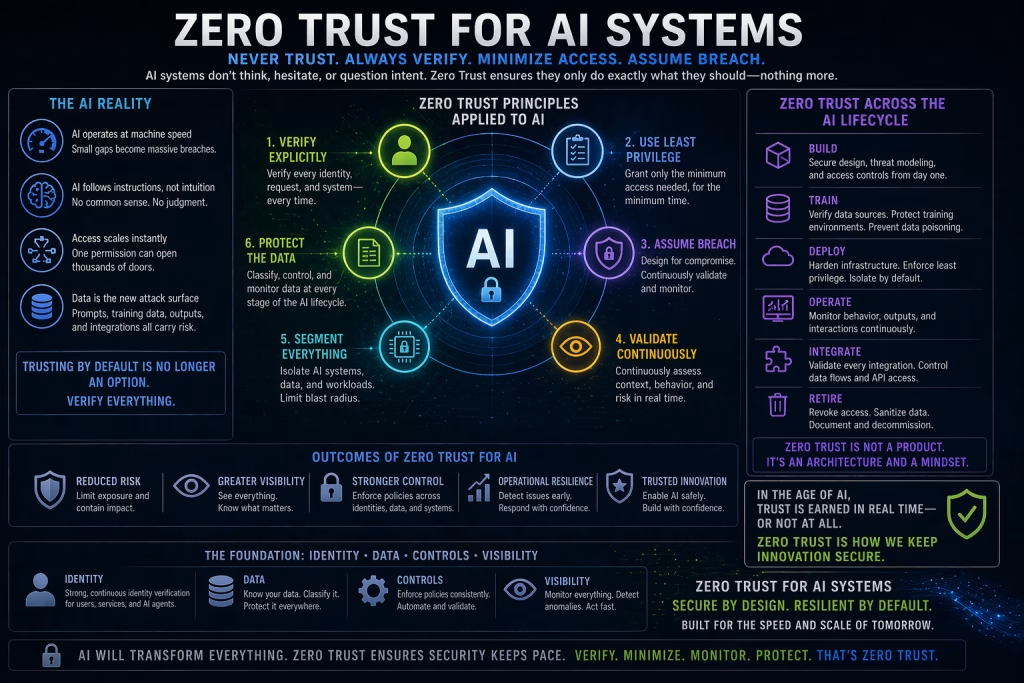
From Principle to Architecture
Across this series, we’ve established a clear progression:
- Cybersecurity fundamentals still apply (Part 1)
- Risk shifts from human inconsistency to machine consistency (Part 2)
- Small gaps become large incidents at machine speed (Part 3)
- Identity and data become the primary control plane (Part 4)
- Trust must be continuously validated, not assumed (Part 5)
The natural conclusion is this:
Security must evolve from static enforcement to continuous verification.
This is not a new idea.
It is the foundation of Zero Trust.
What is new is the environment in which it must now operate:
AI-driven systems that act, respond, and scale without human intervention.
Zero Trust Reframed for AI
Zero Trust has often been described as:
“Never trust, always verify.”
In the context of AI, that definition expands.
It becomes:
- Never trust the user
- Never trust the system
- Never trust the data
- Never trust the output
Every interaction must be:
- Authenticated
- Authorized
- Contextually evaluated
- Continuously validated
AI doesn’t change Zero Trust.
It makes it fully necessary.
From Concept to Control Plane
To operationalize Zero Trust for AI, organizations must anchor their architecture around four control planes:
- Identity
- Data
- Systems (AI + Infrastructure)
- Workflows (Interactions and Automation)
These are not independent layers.
They are continuously interacting, and must be continuously validated.
1. Identity: Verifying Every Actor
Identity is the foundation of Zero Trust, and the first control plane.
In AI environments, identities are not just people.
They include:
- Human users
- Applications
- APIs
- Service accounts
- AI agents
Every identity must be:
- Strongly authenticated (MFA, certificates, tokens)
- Least-privileged by design
- Contextually validated (location, behavior, device, risk signals)
- Continuously monitored
This includes machine-to-machine interactions, which are often overlooked but critical in AI workflows.
If identity is weak, everything built on top of it is exposed.
2. Data: Controlling What Can Be Seen and Used
Data is the second, and most sensitive, control plane.
AI systems don’t just access data.
They:
- Interpret it
- Combine it
- Generate outputs based on it
Zero Trust for data requires:
- Data classification and labeling
- Granular access controls tied to identity
- Encryption in transit and at rest
- Data minimization and segmentation
- Data loss prevention (DLP) for inputs and outputs
Critically, organizations must control not just who can access data, but:
What data can be exposed through AI outputs.
This is where many traditional controls fall short.
3. Systems: Securing AI and Infrastructure
The third control plane is the systems themselves:
- AI models
- Inference services
- APIs
- Cloud platforms
- Supporting infrastructure
Zero Trust requires that systems are not inherently trusted, even internally.
This means:
- Verifying system integrity (model provenance, code integrity)
- Enforcing secure configurations continuously
- Segmenting AI systems from critical environments
- Monitoring system behavior for anomalies
- Validating dependencies (third-party models, libraries, APIs)
AI systems must be treated as high-risk, dynamic components, not static services.
4. Workflows: Governing Interactions at Scale
The final control plane is workflows, the interactions between identities, systems, and data.
This is where AI introduces the most complexity.
Workflows include:
- User prompts and queries
- API calls between services
- Automated decision-making processes
- Data retrieval and augmentation (RAG pipelines)
- AI-generated outputs consumed by downstream systems
Zero Trust requires:
- Validating inputs before processing
- Monitoring interaction patterns
- Enforcing policy at each step of execution
- Validating outputs before they are used or exposed
This ensures that risk is controlled throughout the lifecycle of an interaction, not just at entry points.
Continuous Validation Across All Layers
What ties these control planes together is continuous validation.
At any moment, the organization must be able to answer:
- Is this identity still trusted in this context?
- Is this data appropriate for this interaction?
- Is this system behaving as expected?
- Is this workflow producing safe outcomes?
If the answer changes, controls must adapt in real time.
This is the core of Zero Trust:
Security is not a checkpoint. It is a continuous process.
Architectural Characteristics of Zero Trust for AI
When implemented effectively, Zero Trust for AI systems exhibits several key characteristics:
1. Policy-Driven Enforcement
Access and behavior are governed by dynamic policies, not static rules.
2. Context-Aware Decisions
Security decisions consider identity, behavior, data sensitivity, and risk signals.
3. Real-Time Monitoring and Response
Threats are detected and addressed as they occur, not after the fact.
4. Automation at Scale
Controls operate at machine speed, without reliance on manual intervention.
5. Integrated Visibility
Organizations have end-to-end visibility across identity, data, systems, and workflows.
What This Looks Like in Practice
In a mature environment, this architecture enables:
- AI systems accessing only the data they are explicitly authorized to use
- Outputs being filtered and validated before reaching users
- Anomalous prompt behavior being detected and blocked in real time
- Over-permissioned identities being identified and corrected automatically
- Data exposure risks being flagged before they become incidents
This is not theoretical.
It is the operational model required to manage AI risk at scale.
The Strategic Shift
Zero Trust for AI is not just a technical implementation.
It represents a strategic shift:
From:
- Trusting systems after initial validation
- Relying on static configurations
- Accepting some level of uncontrolled risk
To:
- Continuously verifying all interactions
- Enforcing controls dynamically
- Minimizing risk at every step
Final Thoughts
Artificial Intelligence has not changed the fundamentals of cybersecurity.
It has changed the tolerance for failure.
In a world where systems act autonomously, operate at scale, and execute without hesitation:
- Small gaps become large incidents
- Weak controls become systemic risks
- Static trust becomes a liability
Zero Trust provides the architecture needed to operate securely in this environment.
Not because it is new.
But because it is the only model that aligns with how modern systems, and AI, actually behave.
Closing the Series
This series began with a simple premise:
Cybersecurity fundamentals still work.
But in the age of AI, they must be applied:
- Precisely
- Consistently
- Continuously
Because security is no longer about protecting systems from occasional failure.
It’s about ensuring they operate safely at machine speed, without exception.

William Tulaba is a cybersecurity executive and security engineering leader focused on enterprise security strategy, cloud risk, and security operations.