
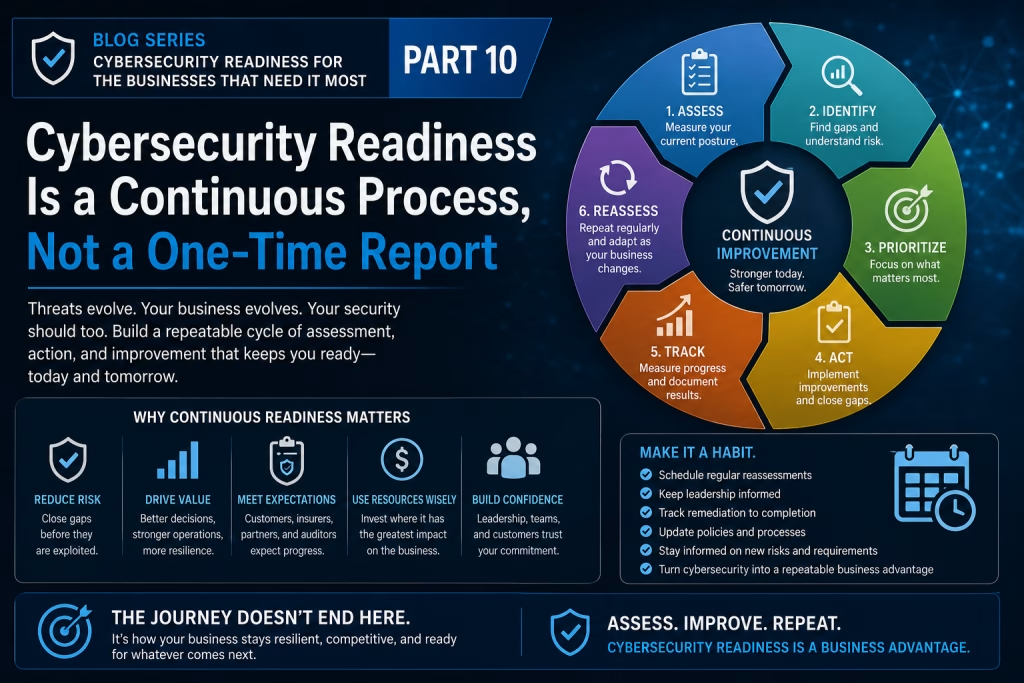
Cybersecurity Readiness Is a Continuous Process, Not a One-Time Report
A cybersecurity report is useful.
It gives the business a snapshot. It helps identify gaps. It creates visibility. It gives leadership something to review. It helps teams understand what needs attention.
But a report is not the finish line.
It is a starting point.
That is one of the most important things to understand about cybersecurity readiness.
A company can complete an assessment, generate a report, review the findings, and still lose value if nothing happens after that.
The real value comes from what the business does next.
Does it assign ownership?
Does it fix the highest-priority gaps?
Does it track progress?
Does it reassess later?
Does leadership stay engaged?
Does the company use the report to improve, or does it save the PDF somewhere and move on?
That is the difference between treating cybersecurity readiness like a checkbox and treating it like a business process.
A Report Captures One Moment in Time
Every cybersecurity assessment is a snapshot.
It reflects what the company knew, what it had in place, and what it reported at that point in time.
That snapshot can be incredibly valuable.
But it can also become outdated quickly.
The business does not stand still.
New employees are hired.
Employees leave.
Roles change.
New vendors are added.
New applications are purchased.
New cloud systems are deployed.
New data is collected.
New customers ask new questions.
New insurance requirements appear.
New vulnerabilities are discovered.
New threats emerge.
A company’s cybersecurity posture changes as the company changes.
That means a report from six months or a year ago may still be useful as history, but it may not reflect the current state.
This is why readiness cannot be a one-time event.
Cybersecurity Gaps Do Not Stay Fixed Forever
Even when a company closes a gap, that does not mean the issue is gone forever.
Cybersecurity controls need ongoing care.
MFA may be enforced today, but new applications may be added later without MFA enabled.
Backups may be tested this quarter, but a new business system may be onboarded without being included in the recovery plan.
Access reviews may happen once, but permissions can start drifting again as employees change roles.
Endpoint protection may be fully deployed today, but new devices, servers, or contractors can create coverage gaps.
Vendor risk may be reviewed during onboarding, but vendors can change their systems, subprocessors, security posture, or business relationship over time.
Incident response may be documented now, but the plan can become stale as teams, systems, legal contacts, and business processes change.
This is why cybersecurity maturity is not just about fixing something once.
It is about building a repeatable process that keeps working as the business evolves.
The Goal Is Continuous Improvement
Cybersecurity readiness does not require every business to become perfect.
That is not realistic.
The better goal is continuous improvement.
A company should be able to say:
“Here is where we were, here is what we improved, here is what still needs work, and here is what we are prioritizing next.”
That is a much healthier conversation than pretending everything is finished.
It also gives leadership a better way to understand cybersecurity investment.
Instead of security being viewed as a never-ending list of problems, it becomes a measurable improvement process.
The business can see progress.
It can see which risks were reduced.
It can see which areas still need attention.
It can see whether previous recommendations were actually completed.
That matters.
Because without tracking, cybersecurity work can become invisible.
Reassessment Should Be Periodic
A structured cybersecurity self-assessment should not be something a company only does once.
It should be repeated.
How often depends on the organization.
For some businesses, an annual reassessment may be enough.
For others, especially those with higher risk, rapid growth, customer security pressure, insurance requirements, or sensitive data, reassessment may need to happen more often.
A company may also reassess after major changes, such as:
- Launching a new product
- Moving to a new cloud platform
- Adding major vendors
- Expanding into new markets
- Going through a merger or acquisition
- Changing IT or security providers
- Experiencing a security incident
- Preparing for cyber insurance renewal
- Responding to customer security requirements
- Making significant changes to systems or data
The point is not to reassess just for the sake of reassessing.
The point is to keep the view of cybersecurity posture current enough to support decisions.
Score History Helps Tell the Story
One of the reasons maturity scoring is useful is that it can show change over time.
A single score is helpful.
A score history is better.
Score history helps answer:
- Are we improving?
- Which areas improved the most?
- Which areas stayed flat?
- Did any areas decline?
- Are we making progress against the roadmap?
- Are investments producing measurable results?
- Are leadership priorities being addressed?
This is especially important for executives and boards.
Leaders do not just want to know that cybersecurity has gaps.
They want to know whether the organization is managing those gaps.
They want to know whether risk is being reduced.
They want to know whether the work being funded is improving the company’s posture.
A score history can help make that visible.
Remediation Tracking Turns Findings Into Action
A report that identifies gaps is only useful if the company does something with those gaps.
That is where remediation tracking matters.
For each major recommendation, the business should know:
- What needs to be done
- Why it matters
- Who owns it
- What the priority is
- What the target date is
- What progress has been made
- Whether the item is open, in progress, accepted, or closed
- What evidence supports completion
Without that tracking, recommendations can sit untouched.
People may agree the issues matter, but nobody owns the next step.
Or the work starts, but leadership loses visibility.
Or the same finding shows up again during the next assessment because it was never fully resolved.
Remediation tracking helps keep the work moving.
It creates accountability.
It turns readiness from a report into a process.
Executive Visibility Should Not Be Annual Only
Cybersecurity should not only reach leadership once a year.
If the only time executives see cybersecurity posture is during an annual assessment, a cyber insurance renewal, an audit, or an incident, the business is missing an opportunity.
Leadership does not need every technical detail.
But leadership should have recurring visibility into:
- Current posture
- Top risks
- Progress against recommendations
- Major changes
- Open decisions
- Areas needing funding or support
- Upcoming reassessment timing
That kind of visibility helps cybersecurity become part of business governance.
It also prevents surprises.
Nobody wants the first serious cybersecurity conversation to happen during a breach, a failed customer review, an insurance renewal problem, or a board concern.
Readiness Needs Ownership
A continuous process also needs ownership.
Someone has to own the assessment cycle.
Someone has to track remediation.
Someone has to update leadership.
Someone has to coordinate with IT, operations, legal, finance, vendors, and business owners.
Someone has to make sure old findings do not disappear.
In a large company, that may be a CISO, GRC leader, security operations leader, risk team, or internal audit function.
In a smaller business, it may be an IT manager, operations leader, founder, managed service provider, or outside advisor.
The title matters less than the accountability.
If nobody owns cybersecurity readiness, it becomes everyone’s concern and no one’s responsibility.
The Report Should Start Better Conversations
A good cybersecurity report should not just say:
“Here are your problems.”
It should help start better conversations.
For example:
- Are we comfortable with this level of risk?
- Which recommendations should we fund first?
- Which risks can we accept temporarily?
- Which gaps could impact customers or insurance?
- Which controls are foundational?
- Which improvements need executive support?
- What should we reassess next quarter?
- What progress do we want to show by the next review?
That is where the real value is.
The report creates a shared language.
The reassessment shows whether the company is improving.
The tracking creates accountability.
Together, they help cybersecurity become more measurable and more manageable.
Do Not Let the Report Become Shelfware
There is a real danger with any assessment report.
It can become shelfware.
The company completes the assessment.
The report is generated.
Everyone agrees it was useful.
Then the business gets busy.
The report gets saved.
The recommendations are not tracked.
The reassessment never happens.
Six months later, the same gaps still exist.
That is not a reporting problem.
That is a process problem.
To avoid that, a company should decide what happens after the report is generated.
At minimum:
- Review the report with leadership.
- Select the highest-priority recommendations.
- Assign owners.
- Define target dates.
- Track remediation.
- Schedule reassessment.
- Use the next assessment to measure progress.
That is how the report becomes useful.
The Best Cybersecurity Programs Show Progress
Strong cybersecurity programs are not perfect.
They are honest.
They know where they are strong.
They know where they are weak.
They can explain what they are improving.
They can show what changed since the last review.
They can tell leadership what needs attention.
They can support customer, insurer, auditor, and board conversations with something more than vague statements.
That is what measurable readiness looks like.
It is not just:
“We completed an assessment.”
It is:
“We completed an assessment, acted on the results, and reassessed to show progress.”
That is the maturity shift.
Where BESTcyberIQ Fits
This is the problem I built BESTcyberIQ to help solve.
Not just creating a one-time report.
Not just generating a score.
Not just giving companies another document to save and forget.
The goal is to make cybersecurity readiness easier to measure, explain, and improve over time.
BESTcyberIQ is designed to help organizations complete a structured NIST CSF 2.0 self-assessment, understand maturity by function, identify priority gaps, produce business-readable reporting, and create a clearer path for reassessment and improvement.
Because businesses do not just need to know where they stand once.
They need a way to keep measuring.
They need a way to show progress.
They need a way to turn cybersecurity from guesswork into something more visible, repeatable, and actionable.
Closing Thought
Cybersecurity readiness is not a one-time report.
It is a continuous process.
The report matters because it creates visibility.
The reassessment matters because the business changes.
The remediation tracking matters because findings need action.
The score history matters because leadership needs to see progress.
That is how companies move from saying they care about cybersecurity to proving they are managing it.
And that is the heart of this series.
Cybersecurity readiness needs receipts.
Not just once.
Over time.

William Tulaba is a cybersecurity executive and security engineering leader focused on enterprise security strategy, cloud risk, and security operations.