
Why Identity and Data Become Non-Negotiable
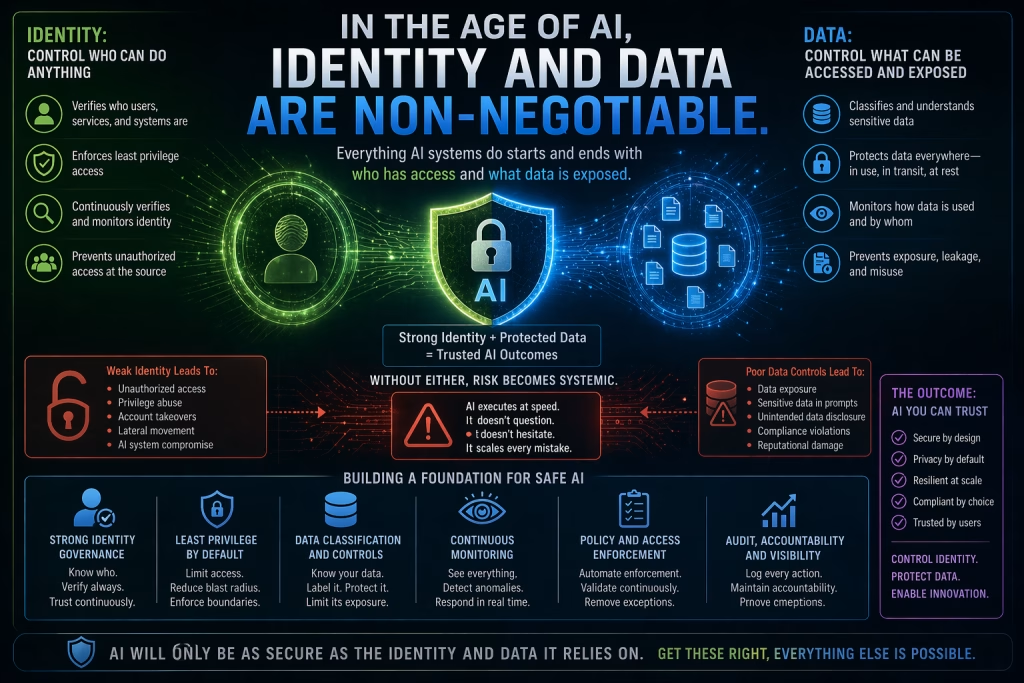
If AI amplifies risk through speed, scale, and repetition, then the question becomes:
Where do you enforce control?
In traditional environments, organizations relied on multiple layers:
- Network boundaries
- Endpoint controls
- User behavior
- Application logic
These layers created redundancy. If one control failed, another might catch the issue.
In AI-driven environments, that redundancy starts to erode.
AI systems operate across cloud platforms, APIs, and distributed services. They interact with data directly and make decisions without human intervention.
This shifts the control plane to two critical elements:
Identity and Data.
Identity: The New, and Only, Perimeter
The concept of a network perimeter is effectively gone.
AI systems don’t sit neatly inside controlled environments. They are:
- Accessed from multiple locations
- Integrated into SaaS platforms
- Invoked through APIs
- Used by both humans and systems
In this model, the only consistent way to control access is through identity.
Every interaction with an AI system, whether initiated by a person, application, or service, must be authenticated and authorized.
This includes:
- Users accessing AI tools
- Applications calling AI APIs
- Background services interacting with models
- Automated workflows executing AI-driven tasks
Identity becomes the enforcement layer.
The Risk of Over-Permissioned AI
One of the most common, and dangerous, patterns in AI adoption is over permissioning.
To “make things work,” organizations often grant:
- Broad access to data sources
- Elevated API permissions
- Shared service accounts
- Minimal restrictions on AI integrations
In a human-driven environment, this might go unnoticed or create limited risk.
In an AI-driven environment, it becomes a multiplier.
An over-permissioned AI system can:
- Access sensitive data it shouldn’t see
- Incorporate that data into outputs
- Repeat that behavior across thousands of interactions
This is not a one-time mistake.
It is a persistent, scalable exposure.
Identity Controls Must Be Precise
To mitigate this risk, identity controls must evolve beyond basic authentication.
Organizations need to implement:
- Least privilege access for all AI systems and integrations
- Role-based and attribute-based access control (RBAC/ABAC)
- Just-in-time (JIT) access for elevated permissions
- Strong authentication mechanisms, including MFA
- Continuous validation of identity context
- Understand Delegated vs Application permissions
This is not just about securing users.
It’s about securing:
- Machine identities
- API identities
- Service-to-service interactions
Because in AI environments, machines are often the ones making decisions.
Data: The Fuel, and the Risk, of AI
If identity controls who can access systems, data determines what those systems can do.
AI systems are fundamentally data-driven.
They rely on:
- Training datasets
- Real-time inputs (prompts, queries, API calls)
- Retrieved data from internal systems
- Generated outputs based on all of the above
This makes data the most critical, and most exposed, asset in AI environments.
The Data Exposure Problem
AI introduces new pathways for data exposure that traditional controls weren’t designed to handle.
These include:
- Sensitive data being included in prompts
- AI systems retrieving data from connected systems without proper filtering
- Generated outputs unintentionally revealing confidential information
- Training data containing regulated or proprietary data
Unlike traditional data access, these exposures can be:
- Indirect
- Repeated
- Difficult to detect without proper monitoring
This is where many organizations underestimate risk.
They secure the system, but not the data flowing through it.
Why DSPM Becomes Critical
This is where Data Security Posture Management (DSPM) becomes essential.
DSPM provides visibility into:
- Where sensitive data exists
- How it is being accessed
- How it is being used by AI systems
- Where exposure risks exist
In an AI context, DSPM helps organizations:
- Identify sensitive data used in training or prompts
- Detect overexposed datasets
- Monitor data access patterns across AI systems
- Enforce data governance policies
Without this visibility, organizations are effectively operating blind.
Controlling Outputs, Not Just Inputs
One of the most important shifts in AI security is the need to control outputs, not just inputs.
Traditional data security focuses on:
- Who can access data
- Where data is stored
- How data is transmitted
AI adds a new dimension:
What data is being generated and exposed through outputs.
Organizations must implement controls such as:
- Data loss prevention (DLP) for AI-generated content
- Output filtering and redaction
- Context-aware data masking
- Logging and monitoring of AI responses
Because once sensitive data is exposed through an AI output, the damage is already done.
Identity + Data = Control
When combined, identity and data controls form the foundation of secure AI systems.
- Identity determines who or what can act
- Data determines what they can access and expose
If either is weak, the system becomes vulnerable.
If both are strong, the organization can maintain control, even at AI scale.
From Best Practice to Requirement
In the past, strong IAM and data security practices were considered best practices.
In the age of AI, they are non-negotiable requirements.
Because:
- AI removes human judgment
- AI operates at scale
- AI amplifies any weakness
This means:
- Over-permissioning is no longer tolerable
- Unclassified data is no longer acceptable
- Limited visibility is no longer sustainable
Organizations must move from:
- “We should have this in place”
to - “This must be enforced without exception”
Looking Ahead
If identity and data define the control plane, the next challenge becomes ensuring those controls are working, continuously.
Because in AI environments, it’s not enough to configure controls once.
They must be validated in real time.
In the next part of this series, we’ll explore how organizations achieve that:
Part 5: Continuous Validation Over Static Trust
Because in an AI-driven world, trust isn’t established once.
It must be continuously proven.

William Tulaba is a cybersecurity executive and security engineering leader focused on enterprise security strategy, cloud risk, and security operations.