
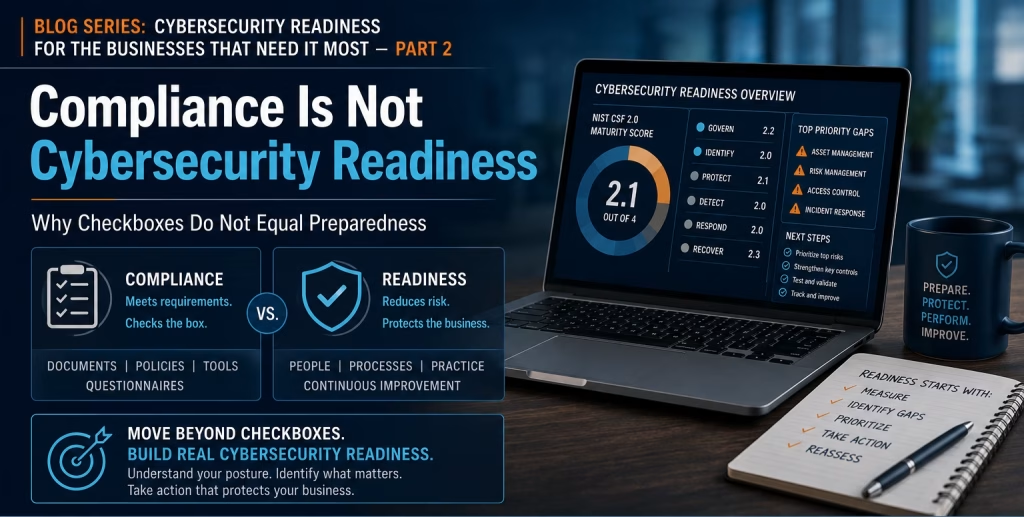
Why Cybersecurity Readiness Is Not the Same as Compliance
If you read Part 1, you already know the problem: many businesses say they measure themselves against the NIST Cybersecurity Framework, but far fewer can actually show the evidence.
That alone is concerning, but the problem gets bigger when companies start confusing compliance with readiness.
They are related, but they are not the same thing.
Compliance ≠ Readiness
I see this pattern often across the companies, industries, and security conversations I interact with.
To be clear, I will never share confidential information about any company I work with, have worked with, or am currently involved with. That would be unethical, and it would defeat the purpose of sharing lessons in a responsible way. The examples I use in this series are generalized patterns from years of experience in technology, cybersecurity, audits, risk discussions, and security program development.
The pattern usually looks something like this:
- A company has policies on paper because a customer or auditor asked for them.
- A tool was implemented because an insurer, board, or business requirement pushed for it.
- A compliance questionnaire gets completed annually so the company can check the box.
On the surface, everything may look fine.
But when an incident happens, a customer asks deeper questions, an insurer tightens requirements, or leadership wants a clearer view of cyber risk, the company may realize the program is not as operational as it looked on paper.
Compliance is about meeting requirements.
Readiness is about being able to protect the business, respond under pressure, and recover when something goes wrong.
You can have compliance without readiness.
And in some cases, a company can believe it is compliant when it is really just maintaining appearances, answering questionnaires, and reacting to the latest request.
Examples I See in the Real World
Here is what I mean.
Backups exist but restores are untested.
The policy says backups happen daily. The backup console shows successful jobs. Someone can answer “yes” on a questionnaire.
But has anyone tested a restore recently?
If the answer is no, the organization may have backup activity, but not true recovery readiness.
Incident response plans exist but no one practices them.
A company may have an incident response plan saved in a folder somewhere. It may even look good during an audit.
But if the team has never walked through the plan, clarified roles, tested communications, or practiced decision-making, then the plan may not hold up when it matters.
A document is not the same as operational readiness.
Security awareness training is completed but behavior does not change.
HR may have the completion report. Employees may have taken the annual training. The organization may be able to show the metric.
But if employees still ignore suspicious emails, bypass reporting processes, or do not know what to do when something looks wrong, then the training is not reducing risk the way it should.
MFA is enabled, but not everywhere it matters.
The checkbox says MFA is implemented.
But is it enforced for all privileged accounts? Is it enabled for remote access? Is it required for cloud administration? What about legacy systems, third-party tools, service accounts, or break-glass accounts?
MFA is one of the best security controls available, but partial implementation can create a false sense of confidence.
These examples are not about blaming companies. They are about showing the difference between having security activity and having measurable cybersecurity readiness.
Compliance alone does not always tell you whether a company is actually prepared.
Why This Matters
Boards, executives, auditors, customers, insurers, and business partners increasingly want more than checkmarks.
They want to understand:
- Where the company is strong
- Where the company is weak
- What the top priorities are
- Which risks matter most to the business
- How progress is being measured over time
Compliance has value. It creates structure. It helps organizations meet obligations. It can force important conversations.
But readiness is what makes security actionable.
Readiness helps leaders understand whether the organization can actually prevent, detect, respond to, and recover from cybersecurity events.
How Businesses Get Trapped in the Compliance Mindset
Many businesses fall into what I think of as the “audit way” of doing security.
That usually means:
- Policies are written for auditors, not for the teams that need to follow them.
- Tools are deployed to satisfy a requirement, not necessarily to solve the root problem.
- Training is completed to meet an annual obligation, not to change behavior.
- Risks are discussed during assessment periods, but not continuously managed.
- Evidence is gathered only when someone asks for it.
It can look good on paper.
It can sound good in meetings.
But it does not always reflect real operational capability.
And when the company starts scaling, onboarding more vendors, supporting larger customers, seeking cyber insurance, preparing for audits, or responding to security questionnaires, the gaps become harder to hide.
Readiness Requires Measurement
The solution does not have to be overly complicated.
But it does need to be repeatable.
Companies need a structured way to measure cybersecurity readiness, not just claim alignment or complete checklists.
That means being able to:
- Assess the current state
- Identify gaps
- Prioritize what matters most
- Translate findings into business language
- Create a plan that is visible to leadership and actionable for the team
- Reassess over time to show progress
That is what many companies are missing.
And that is one of the reasons I built BESTcyberIQ.
The goal is to help organizations move beyond vague statements like “we align with NIST CSF” and toward something more tangible:
- A maturity score across the framework
- Clear visibility into strengths and gaps
- Prioritized recommendations
- A roadmap for improvement
- Evidence that can support leadership, customer, auditor, and insurance conversations
With this approach, compliance and readiness can work together.
Compliance helps define obligations.
Readiness helps prove whether the organization is prepared.
Closing Thought
Compliance tells you whether you are checking boxes.
Readiness tells you whether your cybersecurity program can actually support and protect the business.
Too many companies stop at compliance. They say, “We are NIST-aligned,” but they cannot show how they measured that alignment, what gaps they found, or what they are doing next.
The good news is that this does not have to be complicated.
A structured self-assessment is a practical starting point. It helps identify gaps, prioritize next steps, and begin measuring progress in a way that leadership can understand and teams can act on.
That is the bridge from guesswork to measurable cybersecurity readiness.
And that is the gap BESTcyberIQ is designed to help close.

William Tulaba is a cybersecurity executive and security engineering leader focused on enterprise security strategy, cloud risk, and security operations.