
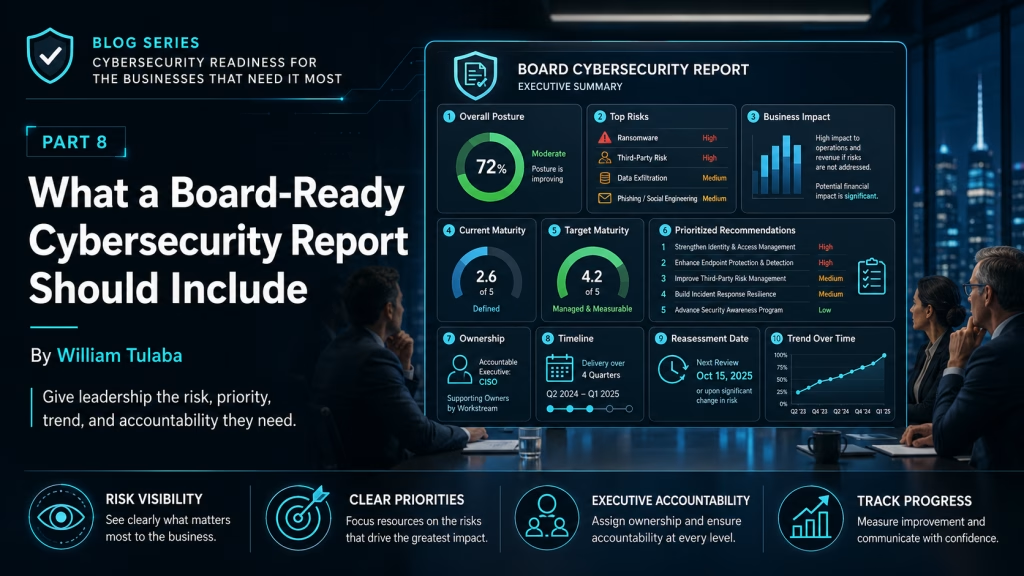
What a Board-Ready Cybersecurity Report Should Include
Cybersecurity reporting can easily become too technical.
That is not because security teams are trying to make it confusing. It is usually because cybersecurity work involves a lot of details: alerts, vulnerabilities, tools, tickets, policies, logs, endpoints, identities, vendors, exceptions, incidents, and control gaps.
Those details matter.
But they are not always what executives, boards, owners, or business leaders need first.
Leadership does not need every technical finding dumped into a report.
They need to understand risk.
They need to understand priority.
They need to understand trend.
They need to understand accountability.
And most importantly, they need to understand what decisions or support are needed from them.
That is the difference between a technical report and a board-ready cybersecurity report.
A Board-Ready Report Should Start With the Current Posture
The first thing a cybersecurity report should answer is simple:
Where do we stand today?
That does not mean the business needs a false sense of precision or a complicated scoring model that nobody understands.
But it does need a clear summary of current posture.
A useful report should show whether the organization’s cybersecurity program is strong, developing, inconsistent, or at risk in key areas.
For a NIST CSF 2.0-based report, that may mean showing maturity across:
- Govern
- Identify
- Protect
- Detect
- Respond
- Recover
This gives leadership a structured view of the program.
It helps them see whether the company is mature in some areas but weaker in others.
That matters because cybersecurity risk is rarely evenly distributed.
A company may have strong protection controls but weak incident response.
It may have decent backups but poor recovery testing.
It may have endpoint tools but weak governance.
It may have policies but limited executive reporting.
A good report makes those differences visible.
It Should Highlight the Top Risks
Executives do not need a 50-item list of everything that could be improved.
At least not first.
They need to know what matters most.
A board-ready report should identify the top cybersecurity risks or gaps that deserve attention.
That may include things like:
- MFA gaps across critical systems
- Untested backup restores
- No formal incident response owner
- Inconsistent access reviews
- Limited logging or monitoring coverage
- Weak vendor risk process
- No vulnerability management cadence
- Outdated policies
- Limited executive visibility
- Poor documentation of controls
The key is prioritization.
If everything is critical, nothing is critical.
A good report should help leadership understand which issues create the most business risk and why they should be addressed first.
It Should Explain Business Impact
This is where many cybersecurity reports fall short.
They describe the technical issue but do not clearly explain why the business should care.
For example, saying:
“Backup restore testing is not performed regularly.”
That is useful, but it is incomplete.
A stronger business-focused explanation would be:
“Without regular restore testing, the business may not know whether critical systems can be recovered within acceptable timeframes during a ransomware event, outage, or data loss incident.”
That connects the control gap to business impact.
The same applies to other findings.
Weak access reviews are not just an identity issue. They can lead to excessive permissions, insider risk, audit findings, and unauthorized access.
Limited logging is not just a technical visibility issue. It can delay investigation, increase dwell time, and make incident response harder.
No incident response owner is not just a documentation gap. It can create confusion during a crisis when fast decisions matter.
Executives need that translation.
They need to understand how cybersecurity gaps can affect operations, revenue, customers, reputation, compliance, insurance, and decision-making.
It Should Show Current Maturity
A good cybersecurity report should not just say whether a control exists.
It should show maturity.
As discussed in Part 6, yes-or-no answers can create false confidence.
A board-ready report should help leadership understand whether controls are:
- Informal
- Documented
- Implemented
- Managed
- Optimized
Or whatever maturity language the organization uses.
The exact labels matter less than the meaning.
The goal is to show how reliable and repeatable the control really is.
For example:
- “Incident response plan exists” is not enough.
- “Incident response is documented but not tested” is better.
- “Incident response is tested annually with lessons learned tracked” is stronger.
Maturity gives leadership a more realistic view of readiness.
It also helps avoid the trap of saying “yes” to a control that only partially exists.
It Should Show Target Maturity
Current maturity is important, but it is only half the story.
A useful report should also show target maturity.
Not every company needs to be a level 5 in every area.
That is an important point.
Cybersecurity maturity should reflect the organization’s size, industry, risk profile, customer expectations, regulatory obligations, data sensitivity, and business goals.
For some areas, the target may be basic consistency.
For others, especially identity, backups, incident response, and critical system protection, the target may need to be higher.
A board-ready report should help leadership understand:
- Where the company is today
- Where it should reasonably be
- Which gaps matter most
- Which areas require investment
- Which areas are acceptable for now
This creates a better conversation than simply saying the company is “good” or “bad” at cybersecurity.
It allows leadership to make risk-based decisions.
It Should Include Prioritized Recommendations
A cybersecurity report should lead to action.
If a report only identifies problems, it is incomplete.
Leadership needs to know what should happen next.
Recommendations should be clear, practical, and prioritized.
For example:
Instead of:
“Improve identity security.”
Say:
“Enforce MFA across all privileged accounts, remote access paths, and critical business applications within 60 days.”
Instead of:
“Improve backup maturity.”
Say:
“Perform and document a restore test for critical systems, define recovery owners, and review recovery time expectations with leadership.”
Instead of:
“Improve incident response.”
Say:
“Assign an incident response owner, update the response plan, and conduct a tabletop exercise within the next quarter.”
Good recommendations should help answer:
- What should be done?
- Why does it matter?
- Who should own it?
- How urgent is it?
- What is the expected outcome?
- How will progress be measured?
That is what turns a report into a roadmap.
It Should Assign Ownership
One of the biggest reasons security gaps stay open is unclear ownership.
Everyone agrees the issue matters.
Nobody owns the fix.
A board-ready cybersecurity report should identify who needs to be accountable for each major recommendation.
That does not mean one person has to do all the work.
But there should be a clear owner.
For example:
- Identity and access gaps may be owned by IT or IAM.
- Backup and recovery gaps may be owned by infrastructure or operations.
- Vendor risk gaps may be owned by procurement, legal, risk, or security.
- Policy gaps may be owned by security, compliance, or leadership.
- Incident response gaps may be owned by security, IT, legal, and executive leadership together.
Ownership creates accountability.
Without ownership, recommendations become suggestions.
And suggestions are easy to ignore.
It Should Include a Timeline
A report should not leave every recommendation floating in the future.
Leadership needs a sense of timing.
That does not mean every item needs a detailed project plan, but the report should separate work into practical timeframes.
For example:
- Immediate priorities
- 30-day actions
- 60-day actions
- 90-day actions
- Longer-term improvements
This helps the business avoid two common problems.
The first problem is trying to fix everything at once.
That usually fails.
The second problem is treating everything as “future work.”
That also fails.
A timeline creates momentum.
It helps leadership understand what should happen now, what can wait, and what requires planning or budget.
It Should Show Trend Over Time
A single report is useful.
A trend is better.
Cybersecurity readiness should not be measured once and then forgotten.
A board-ready report should help the organization understand whether posture is improving, staying flat, or getting worse.
That may include:
- Current score compared to prior score
- Improvements by NIST CSF function
- Closed recommendations
- New gaps identified
- Areas where maturity declined
- Progress against roadmap items
- Reassessment history
Trend matters because cybersecurity is not static.
The business changes.
Systems change.
People change.
Vendors change.
Threats change.
Regulatory and customer expectations change.
A good reporting process helps leadership see whether cybersecurity maturity is keeping up with the business.
It Should Include a Reassessment Date
Every cybersecurity report should have a “what happens next” moment.
That includes a reassessment date.
A report without a reassessment plan can become a snapshot that slowly goes stale.
A practical reassessment date helps keep the business accountable.
Depending on the organization, reassessment may happen:
- Quarterly
- Semi-annually
- Annually
- Before cyber insurance renewal
- Before major customer reviews
- After major business or technology changes
- After significant incidents or near misses
The frequency depends on the business.
But the idea is simple:
If cybersecurity readiness matters, it should be reviewed again.
It Should Be Understandable Without a Security Translator
This may be the most important point.
A board-ready cybersecurity report should be readable by someone who is not living inside the security program every day.
That does not mean dumbing it down.
It means translating technical detail into business meaning.
The report should be clear enough that an executive can understand:
- What is the current state?
- What are the biggest risks?
- What decisions are needed?
- What should be funded?
- What should be tracked?
- Who owns the next step?
- When will this be reassessed?
If the report requires a one-hour explanation before anyone understands it, the report is not doing its job.
What the Report Should Not Do
A board-ready report should also avoid overpromising.
It should not imply that the company is secure because an assessment was completed.
It should not imply certification unless a formal certification process exists.
It should not bury major risks in technical language.
It should not overwhelm leadership with low-level findings before explaining business impact.
It should not present a score without context.
It should not make every gap sound equally urgent.
A good cybersecurity report should be honest, useful, and decision-oriented.
Where BESTcyberIQ Fits
This is one of the reasons I built BESTcyberIQ to focus on business-readable reporting.
A cybersecurity self-assessment is valuable, but the output matters.
If the results are too technical, leadership may not act.
If the results are too vague, security teams cannot use them.
If the results are not prioritized, the business does not know where to start.
BESTcyberIQ is designed to help organizations complete a structured NIST CSF 2.0 self-assessment and turn the results into a clearer view of maturity, priority gaps, and recommended next steps.
The goal is not to create a report that sounds impressive and sits in a folder.
The goal is to create something the business can use.
A report that helps leadership understand posture.
A report that helps teams prioritize work.
A report that helps the organization show progress over time.
Closing Thought
Executives do not need every cybersecurity detail.
They need the right details.
They need to understand posture, risk, priority, maturity, ownership, timeline, and progress.
That is what makes a cybersecurity report board-ready.
Not the length.
Not the number of charts.
Not the amount of technical language.
The value is whether the report helps the business make better decisions.
Because cybersecurity readiness is not just about finding gaps.
It is about turning those gaps into action.

William Tulaba is a cybersecurity executive and security engineering leader focused on enterprise security strategy, cloud risk, and security operations.