
Continuous Validation Over Static Trust
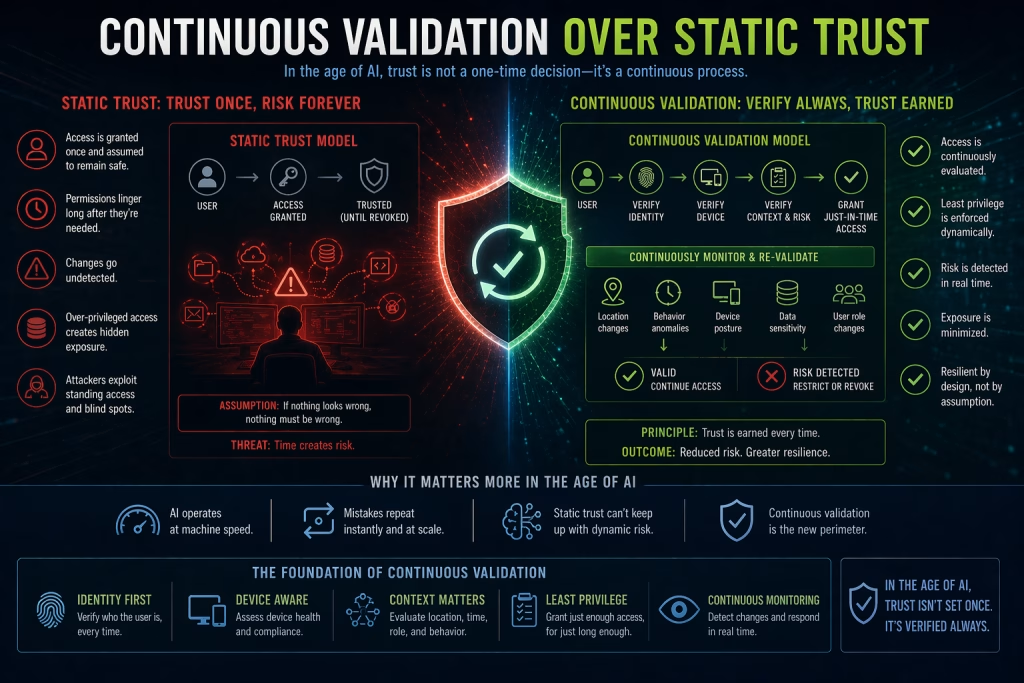
If there is one assumption that has quietly shaped cybersecurity for years, it’s this:
Once something is trusted, it remains trusted.
A user authenticates successfully.
A system is granted access.
A configuration is approved.
And from that point forward, we assume things will behave as expected.
In traditional environments, that assumption, while imperfect, was often manageable.
In AI-driven environments, it becomes a liability.
The Problem with Static Trust
Most security controls are designed to make decisions at a single point in time:
- Access is granted during login
- Permissions are assigned during provisioning
- Configurations are validated during deployment
After that, the system is expected to operate within those boundaries.
This model works when:
- Behavior is relatively predictable
- Changes happen slowly
- Humans are involved in decision-making
AI changes all three.
AI Introduces Continuous Change
AI systems are not static.
They:
- Process new inputs constantly
- Generate dynamic outputs
- Interact with multiple systems in real time
- Evolve based on usage patterns and data
- Models are upgraded & enhanced
Even if the underlying model doesn’t retrain continuously, the context in which it operates is constantly changing.
That means a decision that was safe at one moment may not be safe the next.
Static trust cannot keep up with dynamic behavior.
Trust Becomes a Moving Target
In an AI environment, trust is no longer binary.
It’s not simply “trusted” or “untrusted.”
It is:
- Contextual
- Time-dependent
- Behavior-driven
A user with valid credentials may still pose risk if their behavior changes.
An AI system operating within its permissions may still produce unsafe outputs.
An API integration may behave differently based on the data it receives.
This creates a new requirement:
Trust must be continuously evaluated, not assumed.
From Configuration to Validation
Traditional security focuses heavily on configuration:
- Set access policies
- Define roles and permissions
- Configure data controls
- Deploy monitoring tools
These are necessary, but no longer sufficient.
In AI environments, organizations must move beyond configuration to validation.
This means continuously answering questions like:
- Is this access still appropriate right now?
- Is this behavior consistent with expected patterns?
- Is this output safe given the data involved?
- Has anything changed that increases risk?
Security becomes an active process, not a one-time setup.
Monitoring Behavior, Not Just Events
Traditional monitoring often focuses on discrete events:
- Login attempts
- File access
- Configuration changes
- Network activity
In AI systems, this approach falls short.
Because risk is not always tied to a single event, it emerges through patterns of behavior.
Organizations must shift toward monitoring:
- User behavior over time
- AI prompt patterns and anomalies
- Output consistency and risk signals
- API interaction patterns
- Data access trends
This enables detection of issues such as:
- Prompt injection attempts
- Gradual data exfiltration
- Misuse of AI capabilities
- Drift in system behavior
The goal is not just to detect events, but to understand intent and impact over time.
Validating Outputs, Not Just Inputs
One of the most significant gaps in traditional security models is the assumption that:
If the input is controlled, the output will be safe.
AI breaks that assumption.
Even with controlled inputs, AI systems can:
- Generate unexpected responses
- Combine data in unintended ways
- Surface sensitive information indirectly
This means organizations must validate:
- What the system produces
- How outputs are being used
- Whether outputs introduce risk
Controls such as:
- Output filtering
- Context-aware redaction
- Data loss prevention (DLP)
- Response monitoring
become essential components of security.
Automation Becomes Mandatory
Continuous validation cannot be performed manually.
The speed and scale of AI systems require:
- Automated policy enforcement
- Real-time monitoring and alerting
- Behavioral analytics
- Automated response mechanisms
Security teams must rely on systems that can:
- Evaluate risk continuously
- Enforce controls dynamically
- Respond to anomalies in real time
This is not about replacing humans.
It’s about enabling humans to operate effectively in an environment that moves at machine speed.
The End of “Set It and Forget It”
Perhaps the biggest mindset shift is this:
There is no longer a point where security is “done.”
Controls cannot be:
- Configured once
- Reviewed occasionally
- Trusted indefinitely
They must be:
- Continuously tested
- Continuously monitored
- Continuously improved
In AI environments, anything less creates exposure.
The Natural Evolution Toward Zero Trust
When you combine:
- The need for precise identity control (Part 4)
- The importance of data protection (Part 4)
- The impact of scale and repetition (Part 3)
- The shift from human to machine decision-making (Part 2)
You arrive at a natural conclusion:
Security must operate on continuous validation.
This is the foundation of Zero Trust.
Not as a buzzword, but as a necessary evolution of cybersecurity fundamentals.
Looking Ahead
In the final part of this series, we’ll bring everything together:
Part 6: Zero Trust for AI Systems
Where we move from principle to architecture, defining how organizations can operationalize continuous validation across identity, data, systems, and AI-driven workflows.
Because in the age of AI:
Trust is not established once.
It is continuously proven.

William Tulaba is a cybersecurity executive and security engineering leader focused on enterprise security strategy, cloud risk, and security operations.