
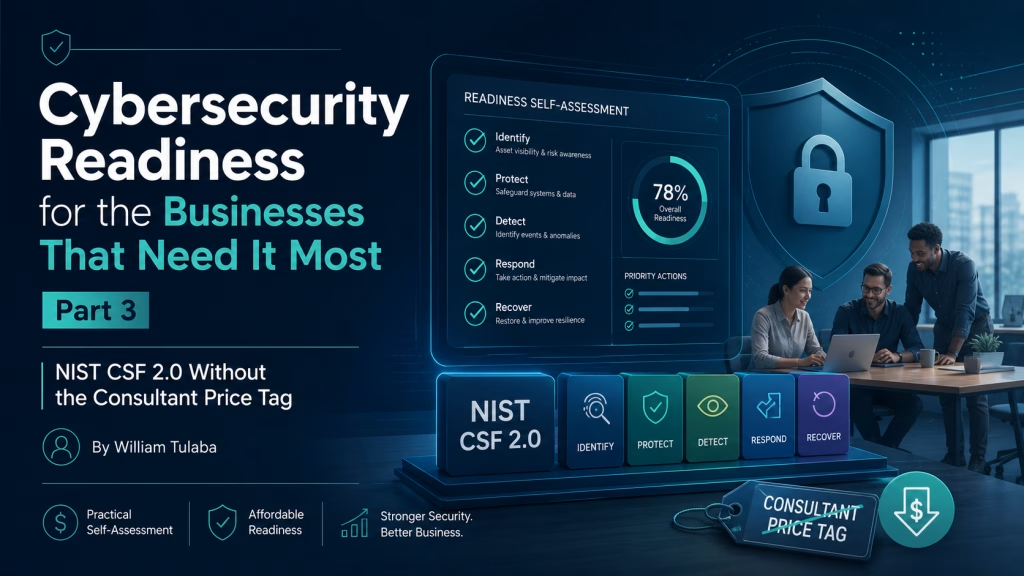
NIST CSF 2.0 Without the Consultant Price Tag
n Part 2, I talked about the difference between compliance and readiness.
Compliance can help a company meet requirements.
Readiness helps a company understand whether it can actually protect the business, respond under pressure, and improve over time.
Once you understand that gap, the next question becomes:
How does a small or mid-sized business actually measure cybersecurity readiness without overcomplicating it or immediately hiring a consultant?
That is where the NIST Cybersecurity Framework 2.0 can be extremely useful.
Not because it magically solves every security problem.
Not because it gives a company a certification.
But because it gives the business a practical structure for asking better questions.
The Problem Is Not the Framework
NIST CSF is not the problem.
The problem is that many companies do not know how to make it practical.
A smaller business may look at cybersecurity frameworks and assume they are only for large enterprises, government contractors, regulated companies, or organizations with dedicated security, risk, and compliance teams.
I understand why.
Frameworks can feel heavy. They can feel academic. They can feel like something that requires months of consulting work, control mapping, documentation reviews, workshops, and spreadsheets before the business gets anything useful out of it.
But NIST CSF does not have to start that way.
At its core, NIST CSF gives companies a way to organize cybersecurity around six major functions:
- Govern
- Identify
- Protect
- Detect
- Respond
- Recover
That structure is simple enough to understand, but broad enough to cover the areas that matter.
The goal is not to turn every small business into a Fortune 500 security program overnight.
The goal is to help the business understand where it stands.
Smaller Businesses Are Being Asked Enterprise-Level Questions
The issue is not whether small and mid-sized businesses have cybersecurity risk.
They do.
The real issue is that many of them are being asked enterprise-level security questions without enterprise-level resources.
A customer may ask whether the company follows NIST CSF.
An insurer may ask about MFA, backups, EDR, vulnerability management, logging, access reviews, and incident response.
A business partner may ask for a security summary.
A board member or executive may ask whether the company is prepared for a cyber incident.
Those are fair questions.
But they can be difficult to answer if the company has never completed a structured assessment.
That is why a lightweight NIST CSF self-assessment can be such a useful first step.
It gives the business a way to move from scattered answers to a structured view of cybersecurity readiness.
What a Lightweight NIST CSF Self-Assessment Looks Like
A practical self-assessment does not need to start with a massive project.
It can start with a focused set of questions.
For example:
- What systems, data, and business processes matter most?
- Which cybersecurity controls are actually in place today?
- Where do we have evidence?
- Where are we relying on assumptions?
- Which areas are informal, undocumented, or inconsistent?
- Which gaps create the most business risk?
- What should be fixed first?
- Who owns the next step?
- How will we measure improvement later?
That is the heart of a useful cybersecurity self-assessment.
It is not about creating paperwork for the sake of paperwork.
It is about creating visibility.
A company should be able to look at the results and say:
“Here is where we are strong, here is where we are weak, here is what we need to prioritize, and here is who needs to act.”
That is a much better place to start than guessing.
Use the Six NIST CSF Functions as a Business Conversation
One of the best things about NIST CSF 2.0 is that it gives cybersecurity leaders, IT teams, executives, and business owners a shared language.
You do not have to begin with every subcategory or control mapped in extreme detail.
You can start by using the six functions as a conversation.
Govern
How does the business oversee cybersecurity risk?
This includes ownership, policies, risk decisions, vendor expectations, roles, and leadership visibility.
For many companies, this is where gaps appear first. They may have tools, but no clear governance model. They may have security activity, but no consistent executive view of risk.
Identify
Does the company know what it needs to protect?
This includes assets, systems, data, users, vendors, business processes, and risk exposure.
If a company does not know what matters most, it cannot prioritize protection effectively.
Protect
What safeguards are in place?
This includes access control, MFA, endpoint protection, security awareness, data protection, backups, and secure configuration.
This is where many companies spend most of their security budget, but the assessment needs to look at whether those protections are complete, consistent, and maintained.
Detect
Can the company identify when something is wrong?
This includes logging, monitoring, alerting, endpoint detection, email security visibility, and suspicious activity review.
A business does not need a massive security operations center to start improving detection. But it does need to know what signals it is collecting and who is responsible for reviewing them.
Respond
Does the company know what to do during an incident?
This includes incident roles, escalation paths, communication plans, investigation steps, legal or insurance contacts, and decision-making.
A response plan that nobody has reviewed or practiced is not the same as readiness.
Recover
Can the company restore operations after disruption?
This includes backups, restore testing, disaster recovery, business continuity, communication, and lessons learned.
Recovery is where cybersecurity becomes very real for the business. If systems are down, customers are impacted, or data is unavailable, the company needs more than good intentions.
Do Not Start by Trying to Be Perfect
One reason companies avoid assessments is because they already know some areas are weak.
That is normal.
The point of a self-assessment is not to prove that everything is mature.
The point is to understand reality.
If vendor risk management is informal, document it.
If incident response is not tested, document it.
If access reviews are inconsistent, document it.
If recovery testing has not happened recently, document it.
If leadership does not receive regular cybersecurity reporting, document it.
That is not failure.
That is the beginning of a real improvement plan.
The companies that concern me are not the ones that find gaps.
Every company has gaps.
The real concern is when a company has no structured way to find, prioritize, and communicate those gaps.
A Practical Assessment Should Produce Practical Output
A NIST CSF assessment should not leave the business with a giant spreadsheet that nobody wants to read.
It should produce something useful.
At minimum, a practical assessment should help the company understand:
- Current maturity by NIST CSF function
- Areas of strength
- Areas of weakness
- Top priority gaps
- Recommended next steps
- Business impact
- Ownership
- A path for reassessment
The output needs to work for both technical and non-technical audiences.
IT and security teams need enough detail to act.
Executives need enough clarity to make decisions.
That is where many assessments fall short. They produce information, but not always understanding.
When Consultants Still Make Sense
To be clear, this is not an argument against consultants.
There are many times when outside expertise is exactly what a company needs.
A consultant may be the right choice for a formal audit, compliance readiness review, penetration test, cloud security assessment, incident response engagement, policy overhaul, or executive advisory support.
But many businesses are not ready to start there.
Sometimes the first step is simply getting organized.
A structured self-assessment can help the company understand its current posture before it spends money on outside help.
It can also make a future consulting engagement more valuable because the company already has a baseline, known gaps, and a clearer sense of priorities.
The First Step Should Be Accessible
Cybersecurity readiness should not only be available to companies with large budgets.
A smaller company should still be able to measure itself against a respected framework.
It should still be able to understand whether it is stronger in protection than detection.
It should still be able to see whether governance is lagging behind tool adoption.
It should still be able to identify whether recovery is assumed or actually tested.
It should still be able to show leadership a clear view of where things stand.
That is the value of using NIST CSF in a practical way.
Not as a binder.
Not as a buzzword.
As a measurement tool.
Why BESTcyberIQ Fits This First Step
This is the exact first step I built BESTcyberIQ around.
The goal is to help businesses complete a structured NIST CSF 2.0 self-assessment, see maturity by function, identify priority gaps, and produce a business-readable report.
It is not meant to replace every consultant, audit, or security professional.
It is meant to help companies stop guessing.
It gives businesses a way to say:
“Here is how we assessed ourselves, here is what we found, and here is what we are doing next.”
That is a much stronger position than saying:
“We believe we are aligned with NIST.”
One is a claim.
The other is a measured starting point.
Closing Thought
NIST CSF 2.0 does not need to be intimidating.
For many businesses, the right first step is not a large consulting project.
The right first step is a practical self-assessment that helps the organization understand where it stands, what gaps matter most, and what needs to happen next.
That is how cybersecurity readiness becomes measurable.
And for the businesses that need cybersecurity readiness the most, measurable is where the work begins.

William Tulaba is a cybersecurity executive and security engineering leader focused on enterprise security strategy, cloud risk, and security operations.