
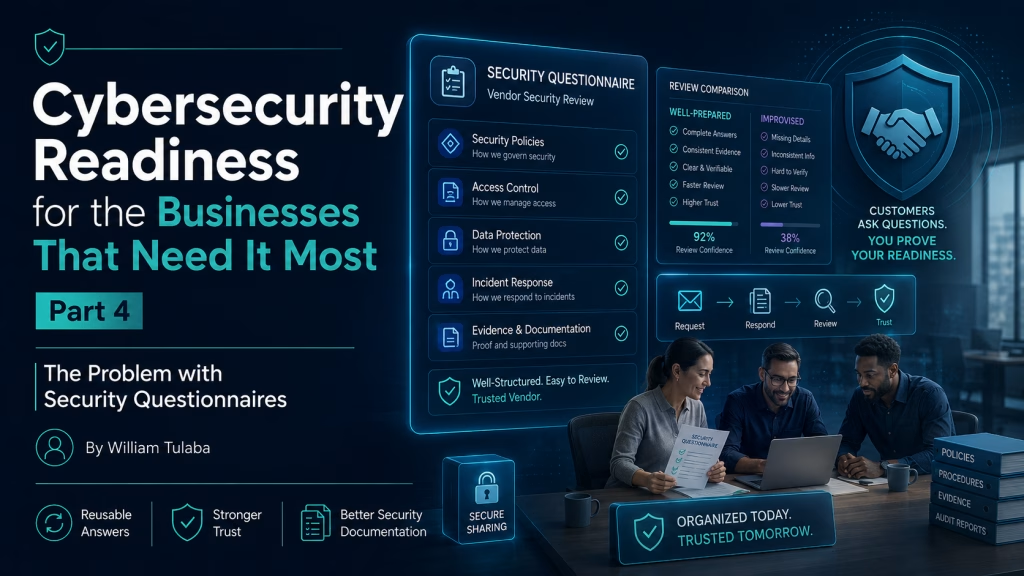
The Problem with Security Questionnaires
At some point, a growing business is going to get one of these emails:
“Before we can move forward, please complete our security questionnaire.”
That sentence can turn a simple sales process, renewal, partnership, or vendor review into a scramble.
Suddenly someone needs to answer dozens, sometimes hundreds, of questions about cybersecurity, privacy, access control, incident response, backups, vulnerability management, policies, vendors, encryption, employee training, logging, monitoring, and business continuity.
For larger companies, there may be a GRC team, a security team, a legal team, and a repository of approved answers.
For smaller and mid-sized businesses, it often lands on one person.
Sometimes that person is in IT.
Sometimes it is the founder.
Sometimes it is operations.
Sometimes it is finance.
Sometimes it is whoever happened to be closest to the customer request when it came in.
And that is where the problem starts.
Security Questionnaires Expose the Real State of the Program
Security questionnaires are not just paperwork.
They often reveal whether a company has a real cybersecurity program or is improvising answers one request at a time.
That may sound harsh, but it is true.
If the organization already has policies, assessment data, control ownership, documented processes, and a clear understanding of its security posture, questionnaires are still annoying, but they are manageable.
If the organization does not have that foundation, every questionnaire becomes a mini-audit.
People start asking:
- Do we have a policy for that?
- Who owns this control?
- Are we actually doing this, or do we just intend to?
- Did we test backups?
- Do we enforce MFA everywhere?
- Do we review access?
- Do we have an incident response plan?
- When was the last risk assessment?
- What framework do we align to?
- Can we prove any of this?
That last question is the hard one.
Because in many companies, the answer may exist somewhere, but not in a clean, reusable, business-ready format.
The Questionnaire Scramble
This is the common pattern.
A customer sends a questionnaire with a due date.
Someone opens it and realizes the answers are spread across multiple places:
- Old questionnaires
- Policy documents
- Security tools
- Ticketing systems
- Vendor portals
- Audit folders
- Email threads
- Spreadsheets
- Someone’s memory (Hopefully they aren’t on vacation)
Then the internal chase begins.
IT gets asked about MFA, endpoint protection, backups, and network security.
HR gets asked about employee training and onboarding.
Legal gets asked about privacy and contracts.
Finance or operations gets asked about insurance, business continuity, and vendor risk.
Leadership may get pulled in to approve answers.
And by the end, the company may submit something that is technically complete, but not always consistent, current, or backed by evidence.
That is not a great operating model.
It is stressful.
It slows down sales.
It creates risk.
And it makes cybersecurity feel reactive instead of managed.
The Risk of Inconsistent Answers
One of the biggest problems with security questionnaires is inconsistency.
A company may answer one customer a certain way in January and another customer differently in June.
Sometimes the difference is intentional because the environment changed.
But often it happens because there is no central source of truth.
Different people answer the same question in different ways.
One questionnaire says the company performs annual access reviews.
Another says quarterly.
One says the company uses a specific framework.
Another says the company is “NIST aligned” without any supporting assessment.
One says backups are tested.
Another says backup testing is planned.
This inconsistency creates real risk.
It can confuse customers.
It can create contractual exposure.
It can make the company look less mature than it actually is.
And internally, it makes it harder to know which answer is true.
Security questionnaires should not be creative writing exercises.
They should be based on current, accurate, reusable security information.
The Real Issue Is Not the Questionnaire
The questionnaire is usually not the real problem.
The questionnaire is a symptom.
The real problem is that the company does not have an organized way to describe its cybersecurity posture.
If a company has never completed a structured assessment, it may not know how to answer questions about maturity, controls, ownership, and gaps.
If policies are outdated, it may not know which statements are still accurate.
If evidence is scattered, it may not know what it can confidently prove.
If there is no owner for security responses, every request becomes a new internal fire drill.
That is why security questionnaires feel painful.
They force the company to confront gaps that already existed.
Customers Are Asking Better Questions
Customers are not wrong to ask these questions.
They are trying to manage their own risk.
If a vendor will access systems, process data, support business operations, integrate with internal platforms, or handle sensitive information, the customer has a legitimate reason to understand the vendor’s security posture.
The questions are also getting more specific.
It is no longer just:
“Do you have security policies?”
It is becoming:
- Do you enforce MFA for all privileged access?
- Do you perform access reviews?
- Do you test backups?
- Do you have an incident response plan?
- Do you monitor security events?
- Do you assess vendors?
- Do you encrypt sensitive data?
- Do you train employees?
- Do you have a vulnerability management process?
- Do you align with a recognized framework?
These are reasonable questions.
But they are difficult to answer well if the company has not done the internal work.
Small Companies Need Reusable Security Documentation
A smaller business does not need a massive GRC department to improve this process.
But it does need reusable security documentation.
That means having a consistent set of materials that can support customer, partner, insurer, auditor, and executive conversations.
At a minimum, this may include:
- A current cybersecurity self-assessment
- A summary of security posture
- A list of top risks and improvement priorities
- Core security policies
- An incident response summary
- A business continuity and recovery summary
- A vendor risk approach
- A data protection overview
- Standard questionnaire answers
- Evidence or references for key controls
This does not mean every customer gets every internal detail.
Companies should be careful about what they share.
But having reusable documentation helps the business respond faster, more consistently, and more confidently.
A Structured Assessment Creates Better Answers
This is where a NIST CSF 2.0 self-assessment becomes useful.
A structured assessment helps the company answer security questions from a stronger position.
Instead of guessing, the business can say:
“We assessed our cybersecurity posture against NIST CSF 2.0, identified our current maturity, documented priority gaps, and are using the results to guide improvement.”
That is not the same as claiming certification.
It is not saying the company is perfect.
It is saying the company is measuring itself.
That matters.
A structured assessment can help answer common questionnaire themes, such as:
- Governance and security ownership
- Asset and data awareness
- Access control and identity management
- Security awareness and training
- Endpoint and email protection
- Vulnerability management
- Logging and monitoring
- Incident response
- Backup and recovery
- Vendor and third-party risk
- Risk prioritization
- Executive visibility
The answers become more consistent because they are grounded in an actual assessment process.
Better Answers Build Trust
Security questionnaires are really about trust.
The customer wants to know:
“Can we trust this company with our data, systems, operations, or business relationship?”
A perfect answer is not always required.
In many cases, customers understand that smaller businesses may not have enterprise-level maturity across every area.
What they usually want to see is honesty, structure, and progress.
They want to know the company understands its risks.
They want to know there is ownership.
They want to know gaps are being addressed.
They want to know security is not being made up at the last minute.
That is why a clear, structured, business-readable security posture summary can be so valuable.
It shows the company is taking the conversation seriously.
The Goal Is to Stop Starting From Scratch
Every security questionnaire should not feel like the first one.
Over time, a company should be building a stronger internal knowledge base.
Each response should improve the next one.
Each assessment should make the next customer review easier.
Each policy update should make the next questionnaire more accurate.
Each remediation effort should improve the company’s posture and its ability to explain that posture.
That is the shift companies need to make.
From reactive responses to reusable readiness.
From scattered answers to structured evidence.
From “Let me check with someone” to “Here is our current posture and here is how we manage improvement.”
Where BESTcyberIQ Fits
This is one of the areas where BESTcyberIQ can help bridge the gap.
A structured NIST CSF 2.0 self-assessment gives companies a better internal foundation for answering security questions.
The goal is not to replace every customer questionnaire or automatically answer every possible security review.
The goal is to help businesses understand their own posture first, so they can respond with more confidence, consistency, and evidence.
BESTcyberIQ is designed to help companies assess maturity, identify priority gaps, produce business-readable reporting, and create shareable summaries that support conversations with leadership, customers, insurers, auditors, and partners.
Because if a company is going to say it aligns with NIST CSF, it should have something behind that statement.
It should have the receipts.
Closing Thought
Security questionnaires are not going away.
If anything, they are becoming more common and more detailed.
The companies that handle them well will be the ones that stop treating each questionnaire as a one-off fire drill.
They will build a repeatable way to measure posture, document answers, identify gaps, and show progress.
That does not require perfection.
It requires structure.
And for many businesses, that structure can start with a practical cybersecurity self-assessment.

William Tulaba is a cybersecurity executive and security engineering leader focused on enterprise security strategy, cloud risk, and security operations.