
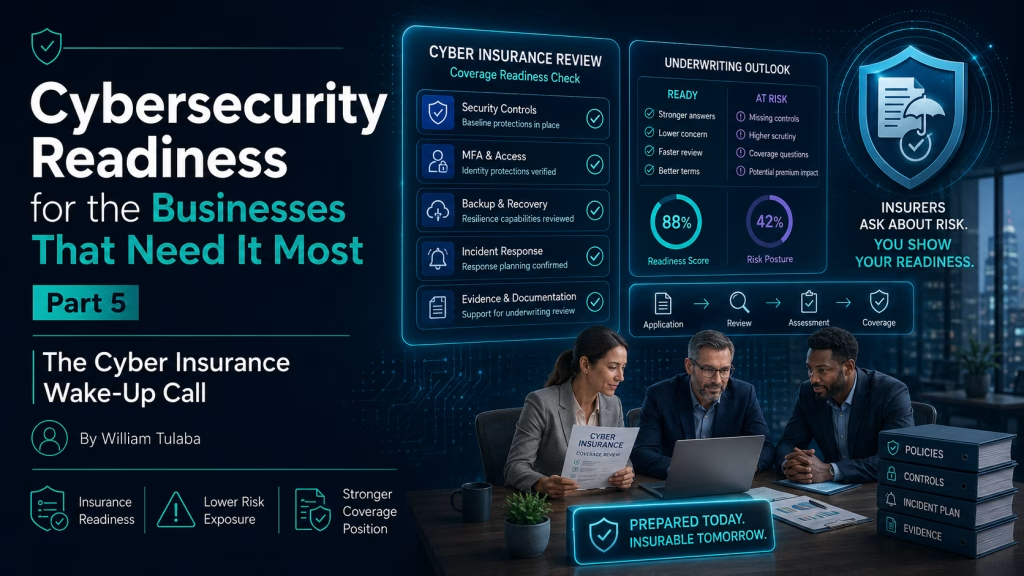
The Cyber Insurance Wake-Up Call
For many businesses, cybersecurity gaps do not become obvious during a planning meeting.
They become obvious when a cyber insurance application shows up.
That is when the questions get specific.
Do you enforce MFA?
Do you use endpoint detection and response?
Do you test backups?
Do you have an incident response plan?
Do you review user access?
Do you monitor logs?
Do you train employees?
Do you have a vulnerability management process?
Do you understand which systems and data are most critical?
These are not abstract cybersecurity questions. They are the kinds of questions that expose whether a company has a real security program or is still relying on assumptions.
For many small and mid-sized businesses, cyber insurance becomes the moment when cybersecurity readiness gets tested.
Insurance Questionnaires Are Not Just Paperwork
It is easy to treat cyber insurance questionnaires like another administrative task.
Someone needs to fill out the form. Someone needs to answer the security questions. Someone needs to get it back to the broker, insurer, or underwriter so the process can keep moving.
But those questions are not just paperwork.
They are a window into the company’s actual cybersecurity posture.
When an insurance questionnaire asks about MFA, backups, incident response, endpoint protection, logging, access reviews, and security awareness training, it is asking about controls that matter in real-world incidents.
The questions may feel repetitive.
They may feel inconvenient.
They may not perfectly match how the company operates.
But they usually point toward an important issue:
Can the business prove that basic cybersecurity controls are in place, maintained, and understood?
That is where many companies struggle.
Not because they are ignoring cybersecurity.
Not because they have done nothing.
But because their answers are often scattered across tools, people, policies, spreadsheets, tickets, and memory.
The Common Pressure Points
Cyber insurance reviews tend to expose the same types of gaps over and over again.
The exact questions vary by insurer, industry, company size, and risk profile, but the pressure points are familiar.
MFA
Multi-factor authentication is one of the first areas that gets attention.
The question is not simply whether MFA exists somewhere.
The better question is:
Is MFA enforced consistently where it matters most?
That includes privileged accounts, remote access, cloud administration, email, VPN, financial systems, and other critical applications.
A company may say it has MFA, but then discover it is only enabled for some systems, some users, or some use cases.
That is a readiness gap.
Backups
Backups are another common area of focus.
Many companies have backups.
The harder question is whether those backups are protected, monitored, and tested.
Can the company restore critical systems?
When was the last successful restore test?
Are backups protected from ransomware?
Who owns recovery?
How long would it take to bring key systems back?
A backup that has never been tested is more of an assumption than a recovery plan.
Endpoint Detection and Response
Endpoint security has also become a major area of interest.
Insurers often want to know whether the company has modern endpoint protection, whether it is deployed broadly, whether alerts are monitored, and whether there is a process for responding to suspicious activity.
Having a tool deployed is a good start.
But readiness depends on coverage, monitoring, response ownership, and follow-through.
Logging and Monitoring
Logging is another area where companies may think they are more mature than they actually are.
Logs may exist, but are they centralized?
Are important systems covered?
Are alerts reviewed?
Who investigates suspicious activity?
Is there an escalation process?
The value of logging is not just collecting data. The value is being able to detect and respond when something looks wrong.
Incident Response
Many businesses have an incident response document somewhere.
That does not mean they are ready.
A practical incident response capability includes clear roles, escalation paths, communication plans, decision-making authority, legal or insurance contacts, and some level of practice.
During an incident, people should not be figuring out the process for the first time.
Access Reviews
User access is another common gap.
Companies add employees, change roles, onboard vendors, grant administrative rights, and integrate new applications over time.
Without a regular access review process, permissions can quietly expand.
Insurance questions around access reviews are really asking whether the company has discipline around who has access to what, why they have it, and whether they still need it.
The Wake-Up Call Usually Comes Too Late
The problem is timing.
Many companies start looking closely at these controls when the insurance application or renewal is already in progress.
That creates pressure.
The business may suddenly realize:
- MFA is not fully enforced.
- Backup testing has not been documented.
- Incident response has not been practiced.
- Endpoint coverage is incomplete.
- Access reviews are informal.
- Logs are not centrally reviewed.
- Policies are outdated.
- Security ownership is unclear.
At that point, the company may still be able to improve, but it is now reacting under a deadline.
That is not the best time to discover foundational gaps.
Cybersecurity readiness should be assessed before renewal time.
Not during the scramble.
Assess Before the Insurance Process Starts
A better approach is to assess cybersecurity readiness before the insurance application or renewal cycle begins.
That gives the business time to understand its current posture, identify gaps, prioritize improvements, and document progress.
The goal is not to create perfect answers overnight.
The goal is to avoid being surprised.
A practical readiness assessment can help the company answer questions like:
- Which insurance-related controls are already in place?
- Which controls are partially implemented?
- Which answers are based on evidence?
- Which answers are based on assumptions?
- Which gaps should be addressed first?
- Who owns each remediation item?
- What should leadership understand before renewal time?
That kind of preparation changes the conversation.
Instead of rushing to assemble answers, the company has a clearer view of where it stands.
A Readiness Report Can Help Organize the Work
This is where a cybersecurity readiness report becomes useful.
A good report should not just produce a score.
It should help the company organize action.
For cyber insurance preparation, that means helping leadership and internal teams understand:
- Current maturity
- Key control gaps
- Business impact
- Priority recommendations
- Ownership
- Next steps
- Areas that may need documentation
- Areas that may require technical remediation
This matters because insurance-related gaps often cross multiple teams.
MFA may involve IT, identity, application owners, and leadership.
Backups may involve infrastructure, cloud teams, business system owners, and vendors.
Incident response may involve security, legal, communications, finance, operations, and executives.
Access reviews may involve HR, managers, application owners, and IT.
A readiness report gives everyone a shared starting point.
It helps move the conversation from:
“Who knows the answer to this?”
To:
“Here is what we found, here is what matters most, and here is what we need to fix.”
Be Careful With Insurance Claims
This part is important.
A cybersecurity readiness assessment does not guarantee cyber insurance approval.
It does not guarantee lower premiums.
It does not guarantee better policy terms.
It does not guarantee that a claim will be approved.
Insurance decisions are made by insurers and underwriters based on their own criteria, risk appetite, policy language, claims history, industry, revenue, controls, and many other factors.
The value of a readiness assessment is different.
It helps a company understand its posture before it is under pressure.
It helps identify gaps that may come up during insurance discussions.
It helps the business prepare more accurate internal responses.
It helps leadership prioritize remediation.
That is still very valuable.
But it should be positioned honestly.
Readiness is not a shortcut to insurance approval.
Readiness is preparation.
Cyber Insurance Should Not Be the First Time You Measure Security
Cyber insurance has become one of the moments where companies are forced to confront cybersecurity maturity.
That can be useful.
But it should not be the only reason a company measures itself.
If the first time a business reviews MFA, backups, EDR, logging, incident response, and access reviews is during an insurance application, the company is already behind.
Those controls matter with or without insurance.
They matter because they help protect the business.
They matter because customers care.
They matter because downtime is expensive.
They matter because recovery is difficult when planning is weak.
They matter because security incidents do not wait for renewal season.
Where BESTcyberIQ Fits
This is another reason I built BESTcyberIQ around practical cybersecurity readiness.
The goal is not to replace an insurance broker, underwriter, attorney, consultant, or formal risk assessment.
The goal is to help businesses understand their cybersecurity posture before they are forced into a reactive conversation.
BESTcyberIQ helps companies complete a structured NIST CSF 2.0 self-assessment, view maturity by function, identify priority gaps, and produce a business-readable report that can support internal planning and readiness discussions.
For a business preparing for cyber insurance renewal, that kind of visibility can be useful.
It helps the company see where it may need improvement before the questions arrive.
It helps organize the work.
It helps leadership understand why the work matters.
And it helps move the company from guessing to measuring.
Closing Thought
Cyber insurance questionnaires can be a wake-up call.
They often reveal whether cybersecurity controls are actually in place, whether they are documented, and whether the company can explain them clearly.
But the best time to discover those gaps is not during the renewal process.
It is before.
A structured cybersecurity readiness assessment gives businesses a way to understand where they stand, identify what needs attention, and prepare for better conversations with insurers, customers, executives, and internal teams.
Cyber insurance may trigger the conversation.
But cybersecurity readiness should start long before the questionnaire arrives.

William Tulaba is a cybersecurity executive and security engineering leader focused on enterprise security strategy, cloud risk, and security operations.