
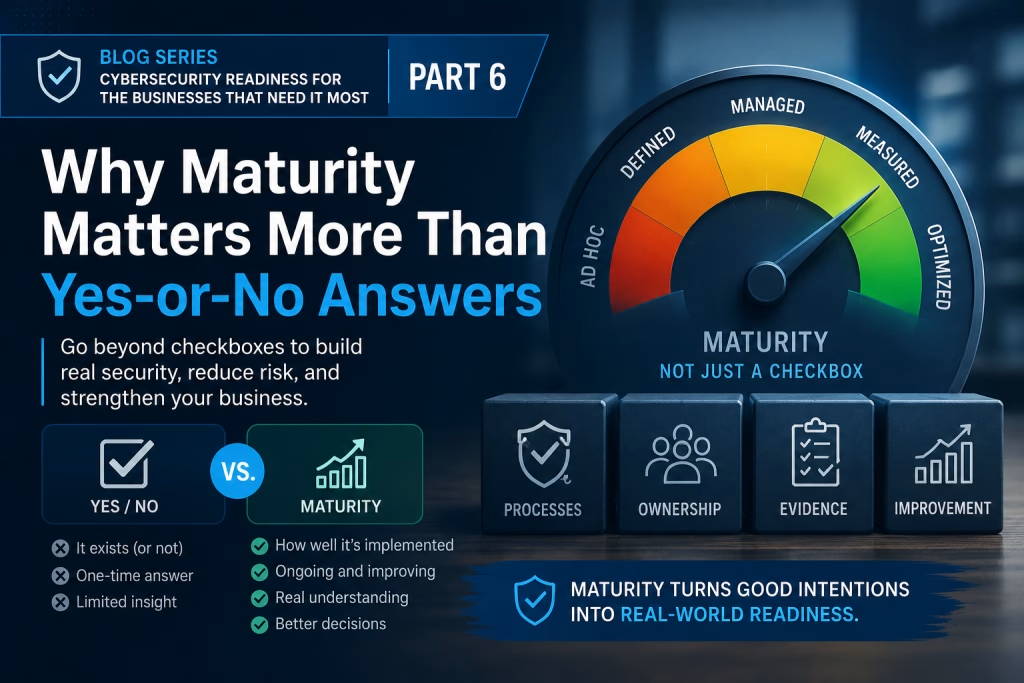
Why Maturity Matters More Than Yes-or-No Answers
A lot of cybersecurity questionnaires ask questions that sound simple.
Do you have an incident response plan?
Do you use MFA?
Do you perform backups?
Do you conduct security awareness training?
Do you review user access?
Do you monitor logs?
Those questions are useful, but they can also be misleading.
Because the answer is often technically “yes,” but the real-world maturity behind that answer can vary dramatically.
That is where companies get into trouble.
A yes-or-no answer may tell you whether something exists.
It does not always tell you whether it is effective, consistent, owned, tested, or improving.
And in cybersecurity, that difference matters.
“Yes” Can Mean Very Different Things
Take incident response as an example.
If someone asks:
“Do you have an incident response plan?”
A company may answer yes.
But what does that actually mean?
It could mean:
- There is a document saved somewhere.
- The document was written three years ago and has not been reviewed.
- The plan exists, but nobody knows who owns it.
- The plan has never been tested.
- The plan does not include legal, communications, leadership, or cyber insurance contacts.
- The plan exists, but the people responsible for using it have never seen it.
- The plan is current, approved, tested, and understood by the right people.
All of those could produce the same checkbox answer.
“Yes.”
But they do not represent the same level of readiness.
That is why maturity matters.
Yes-or-No Checklists Can Create False Confidence
Checklists are not bad.
They are useful for making sure important topics are covered. They help teams organize work. They help customers, insurers, auditors, and business leaders ask basic questions.
The problem is when a checklist becomes the only measurement.
A company can look at a list of controls and feel good because many of the answers are “yes.”
Yes, we have MFA.
Yes, we have backups.
Yes, we have policies.
Yes, we have training.
Yes, we have endpoint protection.
Yes, we have an incident response plan.
But those answers may hide important gaps.
MFA may not be enforced everywhere.
Backups may not be tested.
Policies may be outdated.
Training may be completed but not effective.
Endpoint protection may not cover every system.
Incident response may exist only as a document.
This creates false confidence.
The company thinks it is more prepared than it really is because the checklist makes the program look complete.
A maturity-based approach gives a more honest view.
Maturity Shows How Real the Control Is
Maturity helps answer a better question:
“How well is this actually implemented?”
That is very different from asking whether something exists.
For example, instead of simply asking whether a company has an access review process, a maturity-based assessment looks at how that process works.
Is it informal?
Is it documented?
Is it performed on a regular schedule?
Are business owners involved?
Are privileged accounts reviewed?
Are findings tracked?
Are removals verified?
Is leadership aware of overdue reviews?
That gives a much better picture of readiness.
The same logic applies across the cybersecurity program.
A control becomes more mature when it is:
- Owned
- Documented
- Approved
- Implemented consistently
- Measured
- Tested
- Reviewed
- Improved over time
That is the difference between activity and maturity.
Informal Processes Can Work Temporarily
A lot of smaller businesses start with informal processes.
That is normal.
In a small company, people know each other. The IT person may know who needs access. The founder may approve vendors directly. Backup checks may happen manually. Security decisions may happen in hallway conversations or quick meetings.
That can work for a while.
But informal processes do not scale well.
As the company grows, things become more complicated.
More employees.
More systems.
More vendors.
More customers.
More data.
More compliance expectations.
More insurance questions.
More leadership visibility.
More risk.
At that point, “we usually handle it” is no longer good enough.
The business needs repeatable processes.
It needs ownership.
It needs documentation.
It needs evidence.
It needs a way to know whether the process is actually happening.
That is where maturity becomes important.
Maturity Is About Consistency and Repeatability
A mature cybersecurity control does not depend on one person remembering to do the right thing.
It is built into the way the organization operates.
For example, a mature access review process should not depend on someone remembering once a year that access should be checked.
It should have:
- A defined owner
- A schedule
- A list of systems in scope
- Business reviewers
- Documentation of decisions
- Tracking of removals or changes
- Follow-up for exceptions
- Evidence that the review occurred
That does not mean the process has to be overly complicated.
It means the process has to be reliable.
The same is true for backups, incident response, vulnerability management, logging, vendor reviews, security awareness, and policy management.
Maturity is not about making cybersecurity bureaucratic.
It is about making cybersecurity repeatable.
A Simple 5-Level Maturity View
A practical maturity model does not need to be complicated.
For many businesses, a simple five-level view is enough to understand where they stand.
Level 1: Ad Hoc
The activity may happen sometimes, but it is informal, inconsistent, or dependent on individual effort.
The company may be doing some good things, but there is no reliable process.
Example:
“We handle incidents when they come up, but there is no documented plan.”
Level 2: Defined
The process exists and may be documented, but it is not consistently implemented, reviewed, or measured.
Example:
“We have an incident response plan, but it has not been tested and not everyone knows their role.”
Level 3: Implemented
The process is in use and followed with some consistency.
There is clear ownership, and the control is more than just a document.
Example:
“We have an incident response process, people know their roles, and we use it when issues occur.”
Level 4: Managed
The process is tracked, reviewed, tested, and improved.
There is evidence that the control is operating.
Example:
“We review and test our incident response plan, track lessons learned, and update it based on changes.”
Level 5: Optimized
The process is mature, measured, continuously improved, and integrated into business operations.
Example:
“Incident response is tested regularly, integrated with leadership decision-making, connected to legal and communications processes, and improved through metrics and lessons learned.”
The exact names of the levels can vary, but the concept matters more than the labels.
The question is not simply:
“Do we have this?”
The better question is:
“How mature is it?”
Why This Helps Leadership
Maturity scoring is useful because it gives leadership a clearer view of cybersecurity posture.
A yes-or-no checklist may tell executives that many things are “done.”
A maturity model shows whether those things are actually reliable.
That changes the conversation.
Instead of saying:
“We have backups.”
The company can say:
“Our backup process exists, but restore testing is inconsistent. We need to improve recovery maturity.”
Instead of saying:
“We have an incident response plan.”
The company can say:
“Our incident response plan is documented, but not regularly tested. That is a readiness gap.”
Instead of saying:
“We use MFA.”
The company can say:
“MFA is broadly implemented, but we need to close gaps around privileged access and third-party applications.”
That is a much better conversation.
It is more honest.
It is more actionable.
And it helps leadership understand where investment or attention is needed.
Maturity Helps Prioritize What to Fix First
Not every gap has the same level of risk.
A missing policy update may matter, but it may not be as urgent as unprotected privileged access.
An informal vendor review process may be a concern, but an untested backup and recovery process may create more immediate business risk.
Maturity scoring helps a company compare weaknesses across different areas.
It helps answer:
- Which controls are immature?
- Which gaps create the most risk?
- Which issues are foundational?
- Which improvements would help multiple areas?
- Which items should leadership fund or prioritize first?
That is important because most businesses do not have unlimited time, people, or budget.
They need to focus.
A maturity-based assessment helps turn a long list of security concerns into a more practical roadmap.
Maturity Also Shows Progress
Another benefit of maturity scoring is that it helps show improvement over time.
A company may not move from immature to optimized overnight.
That is fine.
Progress may look like:
- Moving from informal to documented
- Moving from documented to consistently implemented
- Moving from implemented to tested
- Moving from tested to measured
- Moving from measured to continuously improved
That progress matters.
It gives leadership a way to see that cybersecurity work is producing results.
It gives IT and security teams a way to show momentum.
It gives customers, insurers, auditors, and business partners a more thoughtful view of how the company manages risk.
Cybersecurity readiness is not just about where the company is today.
It is also about whether the company is improving.
Where BESTcyberIQ Fits
This is why BESTcyberIQ is built around maturity, not just yes-or-no answers.
A simple checklist can tell a company whether a control exists.
A maturity-based self-assessment helps show how well that control is implemented and whether it is repeatable, documented, tested, and understood.
That matters because businesses need more than checkboxes.
They need a way to understand posture.
They need to identify gaps.
They need to prioritize next steps.
They need to show progress over time.
BESTcyberIQ uses a structured NIST CSF 2.0 self-assessment approach to help companies move from vague statements like:
“Yes, we do that.”
To more useful statements like:
“Here is how mature we are, here is where the gaps are, and here is what we need to improve next.”
That is a stronger foundation for cybersecurity readiness.
Closing Thought
Yes-or-no answers are easy.
But cybersecurity readiness is not always easy.
A company can have a plan, a tool, a policy, or a process and still not be ready.
The real question is whether those things are owned, documented, consistent, tested, measured, and improving.
That is what maturity helps reveal.
And for businesses trying to prove they take cybersecurity seriously, maturity tells a much more honest story than a checkbox ever could.

William Tulaba is a cybersecurity executive and security engineering leader focused on enterprise security strategy, cloud risk, and security operations.