
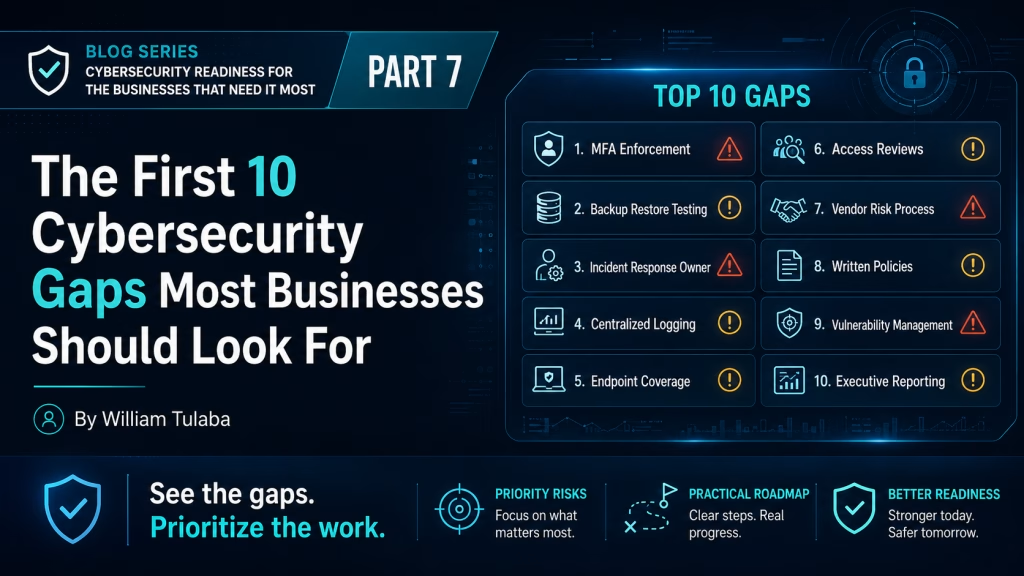
The First 10 Cybersecurity Gaps Most Businesses Should Look For
One of the hardest parts of improving cybersecurity is knowing where to start.
Most businesses already know they have gaps. That is not the problem.
The problem is prioritization.
What should be fixed first?
What creates the most risk?
What matters to customers, insurers, auditors, executives, and the business itself?
What is foundational versus nice to have?
This is where many companies get stuck. They know cybersecurity matters, but the work can feel overwhelming. There are too many tools, too many frameworks, too many questionnaires, too many risks, and not enough time or people to address everything at once.
So the practical question becomes:
If a business is trying to improve cybersecurity readiness, what should it look at first?
There is no perfect universal answer. Every company is different. But there are some common gaps that show up over and over again.
These are the first 10 areas I would look at.
1. MFA Is Not Enforced Everywhere It Matters
Multi-factor authentication is one of the most important security controls a business can implement.
But the key word is enforced.
Many companies say they have MFA, but when you look closer, it may only apply to certain users, certain systems, or certain login methods.
That is where the risk comes in.
A company should look closely at whether MFA is enforced for:
- Remote access
- Cloud platforms
- Administrative accounts
- Financial systems
- Critical business applications
- Third-party access
- Privileged users
- Developer or infrastructure tools
The issue is not whether MFA exists somewhere.
The question is whether MFA protects the access paths that attackers are most likely to target.
If MFA is inconsistent, the company may have a false sense of protection.
2. Backups Exist, But Restore Testing Does Not
Most businesses believe they have backups.
The harder question is:
Can you restore from them?
Backups are not truly useful until they have been tested.
A backup system may show successful jobs every night, but that does not prove the business can recover. Files may be missing. Systems may not restore cleanly. The backup jobs might be misconfigured or pointing to the wrong location. Permissions may break. Recovery times may be longer than expected. Backups may not cover everything the business assumes they cover.
A practical backup review should ask:
- What systems are backed up?
- How often are backups performed?
- Where are backups stored?
- Are backups protected from ransomware?
- Who receives backup failure alerts?
- When was the last restore test?
- What was restored?
- How long did it take?
- What business processes depend on those systems?
If the company has not tested restoration, it does not really know its recovery capability.
It has a hope.
And hope is not a recovery plan.
3. No Clear Incident Response Owner
Every business needs to know who owns incident response.
That does not mean every small business needs a massive incident response team.
But someone needs to be accountable.
When something suspicious happens, who decides what to do next?
Who contacts legal, insurance, leadership, customers, vendors, or law enforcement if needed?
Who coordinates technical investigation?
Who communicates internally?
Who determines whether the event is an incident?
Who has authority to shut down systems, disable accounts, or escalate the issue?
If nobody owns incident response before an incident, the company will waste valuable time during the incident.
A basic incident response owner should be identified, documented, and understood.
Even if the process is simple, it needs to exist.
4. Logging Exists, But It Is Not Centralized or Reviewed
Many companies have logs.
That does not mean they have detection.
Logs may exist inside Microsoft 365, endpoint tools, firewalls, cloud platforms, SaaS applications, identity systems, or servers. But if nobody is reviewing them, correlating them, or alerting on suspicious activity, the company may miss early warning signs.
The question is not only:
“Do we have logs?”
The better questions are:
- Which systems generate security-relevant logs?
- Which logs are centralized?
- Which alerts are reviewed?
- Who reviews them?
- How quickly are alerts investigated?
- Are identity, endpoint, email, cloud, and network signals connected?
- Are critical alerts routed to someone who can act?
For smaller companies, this does not always mean building a full security operations center.
But it does mean knowing what visibility exists and where the blind spots are.
If the company cannot see suspicious activity, it cannot respond to it quickly.
5. Endpoint Protection Coverage Has Not Been Reviewed
Endpoint protection is another area where companies may assume they are covered.
They bought the tool.
They deployed it.
They moved on.
But endpoint coverage changes over time.
New laptops are issued. Servers are added. Contractors connect. Old systems remain online. Devices fall out of management. Agents break. Alerts get ignored. Exceptions are created and never removed.
A coverage review should ask:
- Which endpoints are protected?
- Which endpoints are missing coverage?
- Are servers included?
- Are remote users included?
- Are stale devices still reporting?
- Are alerts being monitored?
- Who owns remediation?
- Are high-risk endpoints treated differently?
Endpoint protection is only useful if it is actually deployed, healthy, and monitored.
A company cannot protect devices it does not know about or tools that are not working as expected.
6. No Regular Access Review Process
Access tends to grow quietly.
Employees change roles. Managers approve temporary access. Vendors get added. Admin rights are granted. Shared accounts appear. Former employees leave. Systems get integrated. Nobody wants to slow the business down.
Over time, people may end up with access they no longer need.
That creates risk.
A basic access review process should answer:
- Who has access to critical systems?
- Who has administrative privileges?
- Are former employees removed quickly?
- Are role changes reflected in access changes?
- Are vendor and contractor accounts reviewed?
- Are shared accounts used?
- Are privileged accounts reviewed more frequently?
- Who approves exceptions?
Access reviews do not have to start as a complicated process.
But they need to happen.
The company should be able to show that access is reviewed, unnecessary permissions are removed, and high-risk privileges are controlled.
7. No Vendor Risk Process
Most companies rely heavily on vendors.
Cloud platforms, payroll systems, accounting tools, CRMs, HR systems, managed service providers, software vendors, data processors, consultants, and outsourced IT providers may all touch sensitive business information.
That means vendor risk matters.
A company does not need an enterprise-grade third-party risk program on day one, but it should have a basic process.
At minimum, it should know:
- Which vendors are critical?
- Which vendors handle sensitive data?
- Which vendors have access to systems?
- Who approves new vendors?
- Are security questions asked before onboarding?
- Are contracts reviewed for security and privacy terms?
- Are high-risk vendors reviewed periodically?
- Is there an owner for vendor risk?
A lot of companies only think about vendor risk after a customer, auditor, insurer, or incident forces the conversation.
That is too late.
Vendor risk should be part of cybersecurity readiness from the beginning.
8. No Written Security Policies
Policies are not exciting.
But they matter.
A written policy gives the business a standard to operate against. It tells employees, managers, IT teams, auditors, customers, and leadership what the organization expects.
The problem is that many companies either have no policies, outdated policies, or policies copied from templates that do not reflect how the company actually works.
A practical policy set may include:
- Acceptable use
- Access control
- Password and MFA requirements
- Incident response
- Data classification
- Vendor risk
- Backup and recovery
- Security awareness
- Vulnerability management
- Remote work
- Asset management
Policies should not exist just to satisfy a questionnaire.
They should be realistic, approved, communicated, and reviewed.
A policy nobody follows is not maturity.
It is paperwork.
9. No Vulnerability Management Cadence
Vulnerability management is not just running a scan once in a while.
It is a repeatable process for finding, prioritizing, assigning, fixing, and verifying vulnerabilities.
Many companies struggle here because they may not have a complete asset inventory, clear patching ownership, severity definitions, remediation timelines, or reporting.
A practical vulnerability management process should answer:
- What systems are scanned?
- How often are scans performed?
- Are endpoints, servers, cloud assets, and external systems included?
- Who reviews findings?
- How are vulnerabilities prioritized?
- Who owns remediation?
- What are the expected timelines?
- Are critical vulnerabilities tracked to closure?
- Are exceptions documented?
- Is progress reported to leadership?
The important word is cadence.
Vulnerability management needs rhythm.
If scans happen randomly and findings are not tracked, the company does not really have a vulnerability management program. It has vulnerability data.
Those are not the same thing.
10. No Executive Reporting
Cybersecurity cannot stay buried in technical conversations.
Leadership needs visibility.
That does not mean executives need every alert, every vulnerability, or every technical detail. But they do need a clear view of risk, priorities, decisions, and progress.
Executive reporting should help answer:
- What is our current cybersecurity posture?
- What are our top risks?
- What has improved?
- What still needs attention?
- Where do we need funding or support?
- Are we prepared for customer, insurer, or auditor questions?
- Are we improving over time?
Without executive reporting, cybersecurity can become invisible until something goes wrong.
That is not good for the security team, and it is not good for the business.
Leadership cannot support what it cannot see.
These Gaps Are Usually Connected
The important thing to understand is that these gaps do not exist in isolation.
Weak asset inventory affects endpoint protection and vulnerability management.
Poor access reviews affect identity risk and incident response.
Weak logging affects detection and investigation.
Untested backups affect recovery.
Missing policies affect customer questionnaires, insurance responses, audits, and employee expectations.
No executive reporting affects funding, prioritization, and accountability.
That is why cybersecurity readiness needs structure.
A company can fix one issue at a time, but it should still understand how those issues connect.
Do Not Try to Fix Everything at Once
The goal is not to look at this list and panic.
The goal is to get honest.
Most businesses will find gaps. That is normal.
The next step is prioritization.
A company should ask:
- Which gaps create the most business risk?
- Which gaps are most likely to appear in customer or insurance reviews?
- Which gaps are foundational for other improvements?
- Which gaps can be fixed quickly?
- Which gaps require budget, ownership, or leadership approval?
- Which gaps need to be tracked over time?
This is where a structured assessment helps.
It turns a long list of concerns into a more practical roadmap.
Where BESTcyberIQ Fits
This is exactly the type of problem BESTcyberIQ is designed to help with.
Most businesses do not need another vague reminder that cybersecurity is important.
They need a way to understand where they stand, identify the gaps that matter most, and decide what to do next.
A structured NIST CSF 2.0 self-assessment can help connect these common gaps to a broader view of cybersecurity maturity.
It can help the business see whether the issue is governance, protection, detection, response, recovery, or a mix of all of them.
It can also help turn scattered concerns into a business-readable report and prioritized recommendations.
Because the question is not just:
“Do we have gaps?”
Every company has gaps.
The better question is:
“Which gaps matter most for our organization, and what should we fix first?”
Closing Thought
Cybersecurity readiness does not start with perfection.
It starts with visibility.
If your business is not sure where to begin, start by looking at the basics:
MFA, backups, incident response, logging, endpoint protection, access reviews, vendor risk, policies, vulnerability management, and executive reporting.
These areas show up again and again because they matter.
A structured assessment helps determine which of these gaps are most important for your business, which ones need immediate attention, and how to build a roadmap that moves cybersecurity from guesswork to measurable readiness.

William Tulaba is a cybersecurity executive and security engineering leader focused on enterprise security strategy, cloud risk, and security operations.