
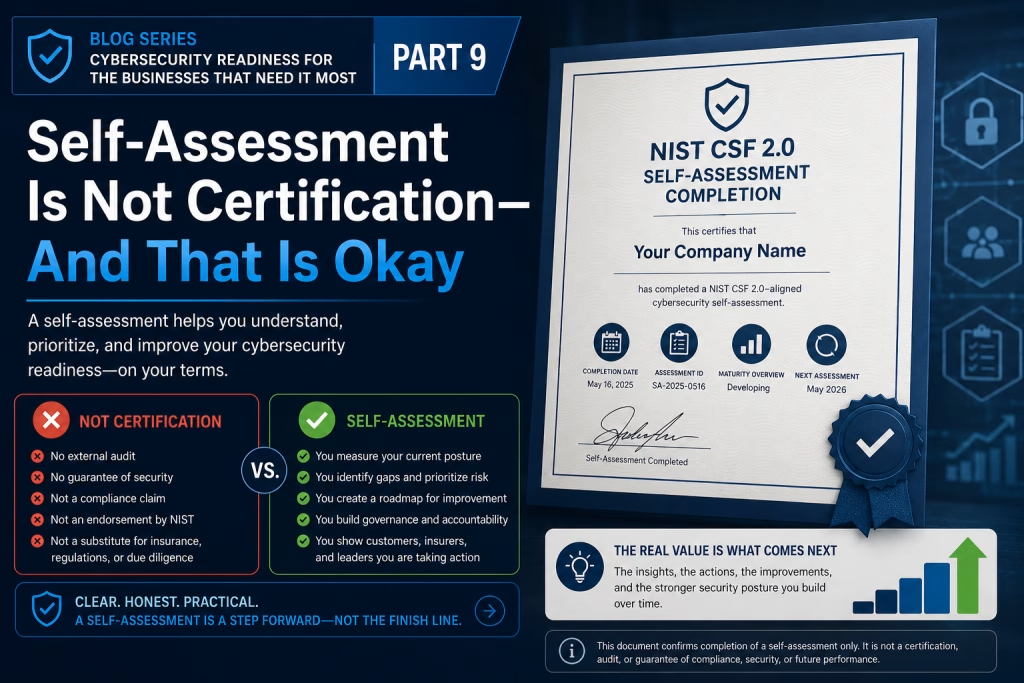
Self-Assessment Is Not Certification — And That Is Okay
One of the questions that comes up when talking about cybersecurity self-assessments is whether a company can get “certified” for completing one.
It is a fair question.
Businesses want something they can show.
Customers ask for evidence. Insurers ask security questions. Executives want proof that cybersecurity is being managed. Boards want visibility. Vendors and partners want confidence.
So, it makes sense that a company would want some kind of document that says:
“We completed this assessment.”
But there is an important distinction to make.
A self-assessment is not the same as a certification.
And that is okay.
NIST CSF Is Not a Formal Certification Program
The NIST Cybersecurity Framework is a framework.
It is not a formal certification program.
That means a company should be careful about saying things like:
“We are NIST certified.”
Or:
“We are NIST CSF compliant.”
Or:
“We passed NIST CSF.”
Those statements can be misleading.
NIST CSF is designed to help organizations understand, manage, and communicate cybersecurity risk. It gives companies a common language and structure for measuring cybersecurity posture.
But it does not work the same way as a formal certification standard where an accredited auditor issues a certification after a defined audit process.
That does not make NIST CSF less valuable.
It just means the language matters.
A company can say it uses NIST CSF.
A company can say it completed a NIST CSF-aligned self-assessment.
A company can say it measured maturity using NIST CSF 2.0.
A company can say it identified gaps and created a remediation roadmap.
Those are useful and honest statements.
But a self-assessment should not be presented as a formal certification.
Why the Distinction Matters
This may sound like wordsmithing, but it matters.
Cybersecurity language carries weight.
If a company tells a customer, insurer, investor, board member, or auditor that it is “certified,” that creates an expectation.
Someone may reasonably ask:
- Who certified you?
- What standard was used?
- Was there an independent audit?
- What evidence was reviewed?
- How long is the certification valid?
- What scope was included?
- What controls were tested?
- What were the exceptions?
If the answer is really, “We completed our own self-assessment,” then calling it a certification creates confusion.
That can hurt trust instead of building it.
Trust comes from being clear.
A self-assessment can be valuable, but it should be described accurately.
A Completion Certificate Can Still Be Useful
Even though a self-assessment is not a certification, there can still be value in a completion certificate or attestation of completion.
The key is wording.
A well-worded certificate should confirm that the company completed a structured self-assessment.
It should not claim that the company is secure, compliant, certified, or approved by NIST.
For example, a reasonable title might be:
NIST CSF 2.0 Self-Assessment Completion Certificate
That is much different from:
NIST CSF Certification
The first one says the company completed an assessment.
The second one implies a formal certification that does not exist in that context.
That distinction protects the company, the customer, and the credibility of the assessment.
What a Completion Certificate Should Say
A good completion certificate should be simple and honest.
It might include:
- Company name
- Assessment framework
- Assessment type
- Completion date
- Assessment ID
- Name of the platform or process used
- Optional maturity score or summary
- Optional reassessment date
- Clear disclaimer language
The most important part is the disclaimer.
A certificate should make clear that:
- The assessment was self-reported.
- The certificate confirms completion only.
- It is not a certification of compliance.
- It is not an audit opinion.
- It is not a guarantee of security.
- It is not an endorsement by NIST.
- It does not guarantee cyber insurance approval, customer approval, or regulatory compliance.
That may feel cautious, but it is the right approach.
Clear boundaries make the certificate more trustworthy, not less.
The Certificate Is Not the Main Value
It is easy to focus on the document.
People like certificates. They are visible. They can be saved, shared, or attached to a report.
But the certificate is not the real value.
The real value is the discipline behind it.
Did the company actually review its cybersecurity posture?
Did it identify gaps?
Did it prioritize remediation?
Did leadership see the results?
Did someone take ownership?
Is there a plan to reassess?
That is what matters.
A completion certificate without meaningful assessment work behind it is just another piece of paper.
But a completion certificate that reflects a real self-assessment can be useful evidence that the company is taking cybersecurity readiness seriously.
Self-Assessment Supports Governance
One of the most important uses of a self-assessment is governance.
Governance is about oversight, accountability, decision-making, and visibility.
A structured self-assessment can help leadership understand:
- How cybersecurity risk is being measured
- Which areas are strong
- Which areas need attention
- What risks should be prioritized
- Who owns remediation
- What progress should be tracked
- When reassessment should happen
That supports better governance because cybersecurity becomes more visible and measurable.
The company is not just saying:
“Security is being handled.”
It can say:
“We assessed our posture, reviewed the results, identified priorities, and are tracking improvement.”
That is a much stronger governance story.
Self-Assessment Supports Planning
A self-assessment also helps with planning.
Most businesses have limited resources.
They cannot fix everything at once.
A structured assessment helps the company decide where to focus.
For example:
- Should the next investment be MFA expansion?
- Backup restore testing?
- Incident response planning?
- Centralized logging?
- Vulnerability management?
- Vendor risk review?
- Security policy updates?
- Executive reporting?
Without an assessment, these decisions may be based on whoever is loudest, whatever tool renewal is coming up, or whatever customer question arrived most recently.
With an assessment, the company has a clearer view of priority.
That makes cybersecurity planning more practical.
Self-Assessment Supports Communication
A self-assessment also helps the company communicate.
That communication may be internal or external.
Internally, it can help security and IT explain risk to leadership.
Externally, it can help support customer, insurer, partner, or auditor conversations.
That does not mean every detail should be shared with everyone.
Companies should be careful about how much security detail they disclose.
But a business-readable summary can be useful.
It can show that the company has a structured approach.
It can show that leadership is aware.
It can show that gaps are being prioritized.
It can show that cybersecurity is not being handled randomly.
That can build trust.
Not because the company is claiming perfection.
Because the company is showing discipline.
Be Honest About the Limits
A self-assessment has limits.
It depends on the accuracy of the answers.
It may not include technical validation.
It may not review all evidence.
It may not test every control.
It may not uncover every weakness.
It may not satisfy a customer, auditor, regulator, or insurer by itself.
That is why the language around self-assessment matters.
A good self-assessment should be viewed as a starting point, not the final word.
It can help prepare for deeper reviews.
It can help organize evidence.
It can help identify where validation is needed.
It can help leadership understand where the company stands.
But it should not be oversold.
Overselling a self-assessment damages trust.
Being honest about what it is and what it is not makes it stronger.
What Companies Should Say Instead
Instead of saying:
“We are NIST certified.”
A better statement would be:
“We completed a NIST CSF 2.0-aligned self-assessment to evaluate our cybersecurity maturity and identify priority gaps.”
Instead of saying:
“We are compliant with NIST CSF.”
A better statement would be:
“We use NIST CSF 2.0 as a framework to assess and improve our cybersecurity readiness.”
Instead of saying:
“This certificate proves we are secure.”
A better statement would be:
“This certificate confirms completion of a self-assessment and supports our internal governance and improvement process.”
Those statements are more accurate.
They are also more credible.
Closing Thought
A self-assessment is not a certification.
And it does not need to be.
The value of a self-assessment is not pretending to be something it is not.
The value is helping a business measure cybersecurity posture, identify gaps, prioritize action, and communicate more clearly.
A carefully worded completion certificate can support that process.
But the real win is not the certificate.
The real win is moving from vague claims to measurable readiness.
Because cybersecurity readiness is not about having a perfect badge.
It is about doing the work, understanding the gaps, and being able to show the receipts.

William Tulaba is a cybersecurity executive and security engineering leader focused on enterprise security strategy, cloud risk, and security operations.